What If We Could Understand a Whale?
AI is helping researchers hear more in sperm whale clicks. The harder task is discovering what matters to the animals making them.
The whales have names, at least among the people trying to understand them. Fingers. Pinchy. A calf called Thumb. Long before anyone could promise an AI translator for the ocean, biologist Shane Gero was returning to Dominica to see which familiar animals were around.
In a 2011 account from Dalhousie University, Gero described becoming attached to individual whales. He had been visiting the Caribbean island since 2005, spending months at a time studying their families. The work involved recording their sounds, but also something less easily accelerated: getting to know who belonged with whom.1
There is a particular frustration in that kind of familiarity. You can recognize an animal, follow its family, watch its young grow, and still be shut out of the exchanges happening beside you. Imagine knowing your neighbors for years without ever understanding a word they say.
Now imagine that, one day, a small part of those exchanges becomes intelligible.
It needn’t be a whale delivering a speech about the mysteries of the deep. Perhaps researchers could establish how a family coordinates leaving a place, or what one animal signals to a particular companion. These are possibilities, not translations we possess. But even a modest discovery could change the experience of listening. A sound you once filed away as wildlife would become something more specific: one animal communicating something to another.
That is the possibility behind Project CETI, the Cetacean Translation Initiative. It brings machine learning and robotics to a question that depends on years of patient fieldwork. The Dominica Sperm Whale Project’s observations, including calves followed from birth through weaning, provide a foundation for the effort.2
The computers have arrived in the middle of a much older relationship.
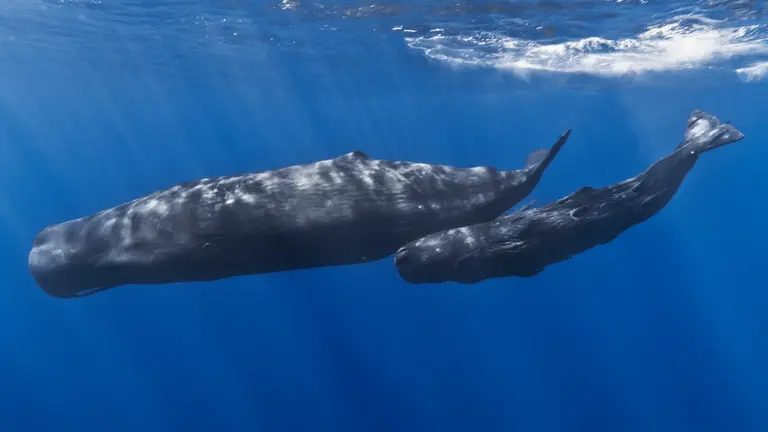
Documentary photograph · Mauritius
Mother and baby sperm whale. A sperm whale and her calf off Mauritius. These are not the Caribbean whales recorded in the coda study; the photograph does not show a decoded conversation.
Credit: Gabriel Barathieu · CC BY-SA 2.0 · Full frame retained; resized and converted for web delivery

A family on the other end
Sperm whales give researchers good reason to keep listening. Females and their offspring live in lasting social units. Adults help care for calves, including nursing young that aren’t their own. The animals also have a sensory life very different from ours: they use echolocation to find their way and hunt in deep water. Sound does work there that our eyes do for us on land.3
For communication, they produce short sequences of clicks called codas. Those are distinct from the click trains used in hunting. Researchers can record an exchange without knowing what it accomplishes, much as you could record a conversation through a wall while missing its words.
It is tempting to supply the missing dialogue yourself. A mother and calf, a departure, a reunion: the imagined subtitles practically write themselves. That temptation is also a research hazard. Recognizing a familiar social situation doesn’t entitle us to give the animals human sentences.
Still, the families matter. A recording stripped of its circumstances could hide the very clue needed to understand it. Who made the sound? Who was close enough to hear? What happened afterward? When a team knows individual animals over many years, a click pattern can be studied as part of a life rather than simply sorted into a folder of similar noises.
The attraction of AI is that it may help researchers notice distinctions they weren’t listening for. An unfamiliar sound can seem repetitive because the listener has yet to learn which differences count.
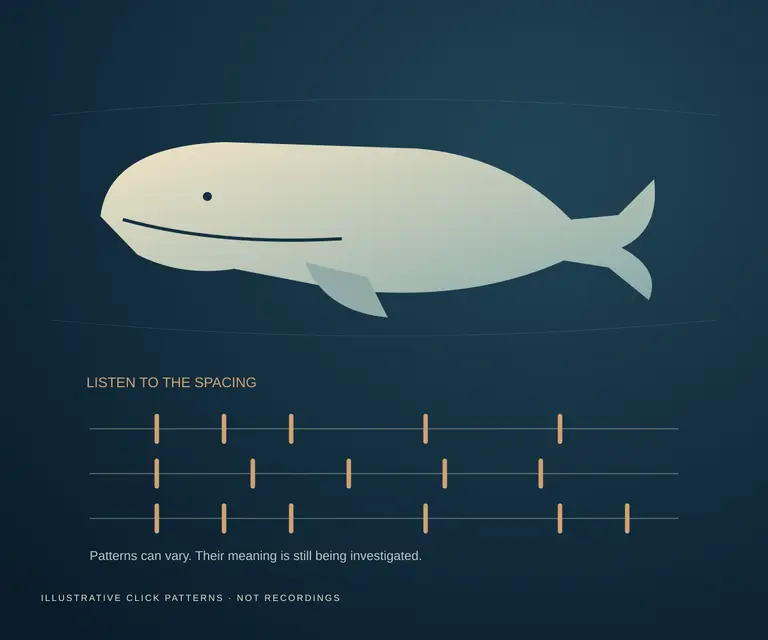
Conceptual explanatory illustration
Patterns, not yet meanings. Sperm-whale codas contain patterns of clicks. These invented sequences illustrate variations in timing and number, not recordings or translated messages. Illustration by The Observatory.
Credit: The Observatory · original illustration created with AI assistance · Full image retained; responsive web delivery
More than a string of clicks
In 2024, researchers led by MIT’s Pratyusha Sharma reported that sperm whale codas have more structure than the familiar catalogue of click patterns captured. The animals could adjust a coda’s duration and add an extra click, with these variations related to the surrounding vocal exchange. Different features combined to make distinguishable calls.4
The team borrowed a little vocabulary from music. There was rhythm, the arrangement of clicks, and tempo, the overall pace. There was also rubato, a stretching or compressing of duration, and ornamentation, the additional click. Looking at exchanges helped reveal variation that treating each call as an isolated specimen could miss.5
You can get a rough feel for the distinction by tapping a short pattern on a table. Repeat it faster. Keep its pace but change the spacing. Add one last tap. You have made several kinds of change without acquiring a larger instrument. This is an illustration of the sound-making possibilities, not a way to speak whale across the kitchen.
The researchers described a “phonetic alphabet.” That phrase needs care. Their finding concerned the organization of sounds, not an alphabet we can read or a dictionary of meanings. The paper did not translate those codas into sentences.4
Subsequent work has widened the listening still further. A 2025 study examined the frequency patterns within codas, rather than timing alone, identifying properties the researchers compared with vowels and changing vowel sounds. As the University of California’s account made clear, the meanings remained unknown.6
So there are differences in the sounds that a simple click count misses. Whether those differences carry particular meanings, and how whales use them, is a further question.
For anyone hoping to chat with a whale, that can sound like an irritatingly small advance. But consider the alternative: trying to understand speech while recording only how many syllables each person used. Before asking what a signal means, you need a decent account of what the signal actually is.
How would we know we understood?
Suppose a future system repeatedly detects a certain call just before whales begin traveling together. It would be easy to label it let’s go. A dashboard could display the phrase. A video could acquire subtitles. The whole thing would look wonderfully convincing.
Yet several explanations would still fit. The call might identify the caller. It might be associated with a particular relationship. Or some other circumstance might produce both the call and the movement. A useful correlation would have become a much stronger claim simply because someone put it into English.
This is where the fantasy of a translation app gives way to the more interesting prospect of an experiment.
CETI’s scientific roadmap describes linking vocal recordings with behavior and eventually testing hypotheses through playback: presenting sounds to whales and studying their responses. It treats machine learning as a way of narrowing the possibilities researchers must investigate, not as an authority that can announce what a whale meant.7
A credible interpretation would have to survive attempts to show it wrong. Does it hold for recordings the system hasn’t encountered? Does the proposed meaning explain responses better than competing ideas? Could carefully controlled changes to a call produce the predicted difference?
Those are difficult questions to ask of animals whose lives continue underwater, with or without our equipment. They also put the animals, rather than a persuasive computer output, in charge of the answer.
And understanding may arrive unevenly. We could learn a great deal about how a family coordinates itself without discovering anything resembling a human conversation. Or we might find distinctions for which our ordinary vocabulary is a poor fit. There is no obligation for another species to organize its world into concepts convenient for us.
That would be part of the pleasure. We wouldn’t be looking for people wearing whales.
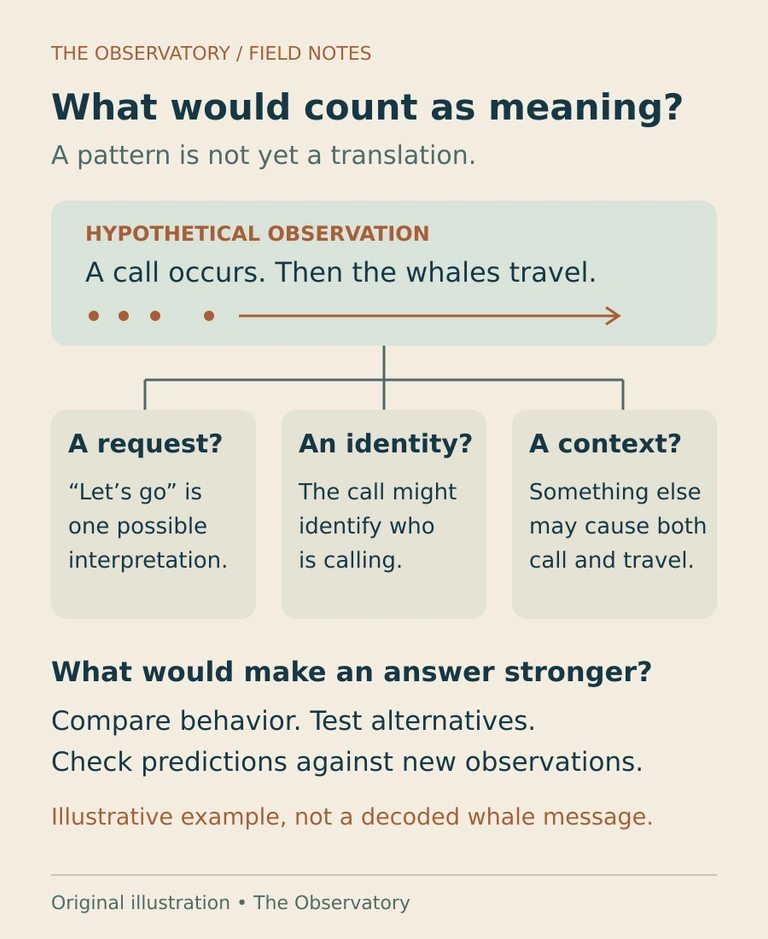
Conceptual explanatory illustration
Testing a possible meaning. A call followed by movement would not, by itself, translate to “let’s go.” This hypothetical example shows competing explanations that behavioral observations and tests would need to distinguish. It is not a decoded whale message or recorded data. Illustration by The Observatory.
Credit: The Observatory · original illustration created with AI assistance · Full image retained; schematic, not measured data
Listening has consequences
One possible discovery is already uncomfortably close to home. In a 2026 study of Eastern Caribbean recordings, researchers found that codas were shorter in the presence of shipping noise and that the distribution of particular sound properties changed. The study connects human activity with changes in whale signals; it does not establish that whales are talking about ships.8
You don’t need that translation to see a reason to pay attention. We are trying to hear animals while adding noise to the place where they communicate.
A better understanding of their calls could eventually help researchers assess which disturbances matter and how animals respond. That is a more practical ambition than holding a philosophical discussion with a sperm whale, though perhaps not a smaller one. Learning enough to interfere less would be a worthwhile use of an extraordinarily powerful technology.
There is an ethical choice here, too. We shouldn’t make an animal’s claim on our consideration depend on whether it can impress us linguistically. A whale that never supplies a sentence we can translate is still a whale with a life to get on with. Listening should make our attention more exact, not turn compassion into an entrance exam.
The imagined breakthrough can remain quite small. A researcher follows a familiar family. A sequence of clicks reaches a recorder. This time, years of observations and careful tests support an interpretation that was previously out of reach. For one brief exchange, the human listener knows a little more about what is happening between those animals.
There might be no message for us in it at all. The whales were addressing one another. We would finally have understood enough to appreciate that.
Sources
Footnotes
Interpreting the language of whales
Katherine Wooler · Dalhousie University
2011
Secondary source
In this article: Long-term observation of individually identified whales and Gero’s fieldwork.
Source 1Katherine Wooler · Dalhousie University · 2011Interpreting the language of whalesSecondary sourceIn this articleLong-term observation of individually identified whales and Gero’s fieldworkView source ↗About us
The Dominica Sperm Whale Project
Scientific institution
In this article: Long-term family observations and the project’s relationship with CETI.
Source 2The Dominica Sperm Whale ProjectAbout usScientific institutionIn this articleLong-term family observations and the project’s relationship with CETIView source ↗Toward understanding the communication in sperm whales
Jacob Andreas and colleagues
iScience · 2022
Scholarly review
In this article: Sperm whale social life, echolocation, codas and the research roadmap.
Source 3Jacob Andreas and colleagues · 2022Toward understanding the communication in sperm whalesiScienceScholarly reviewIn this articleSperm whale social life, echolocation, codas and the research roadmapView source ↗Contextual and combinatorial structure in sperm whale vocalisations
Pratyusha Sharma and colleagues
Nature Communications · 2024
Primary research
In this article: Contextual and combinatorial structure in sperm whale vocalisations, not semantic translation.
Source 4Pratyusha Sharma and colleagues · 2024Contextual and combinatorial structure in sperm whale vocalisationsNature CommunicationsPrimary researchIn this articleContextual and combinatorial structure in sperm whale vocalisations, not semantic translationView source ↗Exploring the mysterious alphabet of sperm whales
Rachel Gordon · MIT CSAIL
2024
Secondary source
In this article: Institutional explanation of rhythm, tempo, rubato and ornamentation.
Source 5Rachel Gordon · MIT CSAIL · 2024Exploring the mysterious alphabet of sperm whalesSecondary sourceIn this articleInstitutional explanation of rhythm, tempo, rubato and ornamentationView source ↗UC Berkeley and Project CETI study shows sperm whales communicate in ways similar to humans
Aubrey Spowart · University of California
2025
Secondary source
In this article: Reported acoustic spectral patterns without a claim of translated meaning.
Source 6Aubrey Spowart · University of California · 2025UC Berkeley and Project CETI study shows sperm whales communicate in ways similar to humansSecondary sourceIn this articleReported acoustic spectral patterns without a claim of translated meaningView source ↗Toward understanding the communication in sperm whales
Jacob Andreas and colleagues
iScience · 2022
Scholarly review
In this article: Proposed semantic validation and playback experiments, not achieved conversation.
Source 7Jacob Andreas and colleagues · 2022Toward understanding the communication in sperm whalesiScienceScholarly reviewIn this articleProposed semantic validation and playback experiments, not achieved conversationView source ↗Evidence for the influence of shipping underwater radiated noise on sperm whale coda structure
Roee Diamant; David F. Gruber; Shane Gero; Gašper Beguš
Ecological Informatics · 2026
Primary research
In this article: Abstract-level evidence on shipping noise and sperm whale coda structure.
Source 8Roee Diamant et al. · 2026Evidence for the influence of shipping underwater radiated noise on sperm whale coda structureEcological InformaticsPrimary researchIn this articleAbstract-level evidence on shipping noise and sperm whale coda structureView source ↗