Your Upstairs Neighbor Lives in a Slightly Different Time
The difference will never explain the noise from their apartment. But clocks sensitive enough to notice it are changing what we can learn about the ground beneath our feet.
An upstairs neighbor has certain advantages. Perhaps a better view. Perhaps more sunlight. Certainly the option of moving a chair at a time you would not have chosen.
There is also the matter of their extra time.
Imagine two otherwise identical clocks, one in your apartment and one directly above it. Leave them running, undisturbed, and the upstairs clock will gradually pull ahead. Neither is broken. Near Earth’s surface, a higher clock runs a little faster than a lower one. This is gravitational time dilation, a consequence of Einstein’s general relativity, and it applies to the building you live in as surely as it does to objects in space.1
Before you renegotiate the rent: the advantage is hopelessly small. For an imagined three-meter separation between clocks, maintained for a year, the difference would be about ten billionths of a second. That estimate isolates the effect of height near Earth’s surface; it is not a calculation of two actual neighbors’ lives, with all their movements and travels.2
Still, there is something difficult to put back in its box here. We tend to treat time as the one thing everyone in a room shares. We can disagree about how long a meeting feels, but somewhere there is supposed to be a correct answer, a common supply of seconds being used up by everyone.
An ordinary building is enough to complicate that picture. And researchers have found ways to make the complication visible at distances far smaller than the space between floors.
A staircase, then something smaller
In 2010, physicists at the US National Institute of Standards and Technology compared two exceptionally accurate clocks. Each used a single electrically charged aluminum atom. To test how height affected their ticking, the team did something reassuringly physical: they jacked up the table supporting one clock.
The lift was 33 centimeters, roughly a foot. The raised clock ran faster, just as predicted.1
There is a pleasing mismatch between the idea and the equipment adjustment. Relativity arrives in our imaginations accompanied by rockets and black holes. In this case, getting a little more distance from the floor did the job.
But what does it mean for a clock to run faster? It does not mean someone upstairs feels a rush, thinks more quickly, or watches their kettle finish in suspiciously good time. Their own clock still measures their seconds normally. The difference emerges when clocks at different heights are compared. Gravitational time dilation concerns elapsed time itself, rather than a faulty mechanism that could be repaired.3
The challenge is that familiar timepieces have plenty of other reasons to disagree. A clock losing a second is usually telling you something about the clock. To find the tiny contribution from gravity, researchers need a reference that is far more dependable than an object assembled from parts that drift.
They turn to atoms.
An atom can absorb light at particular frequencies, corresponding to changes in its internal energy. In an optical atomic clock, researchers tune a laser to one of those transitions. The atoms provide a reference for the laser; the oscillations of the light provide the beats to count. This is not a miniature pendulum hidden inside an atom. It is a way to make the same physical process serve as an extraordinarily consistent standard.4
Now the comparison becomes revealing. If two carefully controlled atomic clocks disagree in the expected way when one is raised, the discrepancy can tell you about their locations, rather than their workmanship.
In 2022, a team at JILA, the joint institute of NIST and the University of Colorado Boulder, brought that comparison inside a single tiny cloud of atoms. Their sample contained about 100,000 ultracold strontium atoms, held by laser light. Instead of raising an entire clock, they compared different heights within the sample itself.
Across roughly a millimeter, they detected the change in ticking rate that gravity predicts.5
A millimeter is a distance you might overlook while lining up two pieces of paper. Yet the atoms at the top and bottom of this sample did not accumulate time at quite the same rate. The researchers weren’t watching little clock hands visibly separate. They were measuring a minute difference in frequency, teasing it out by averaging measurements.
The result did not mean gravity suddenly became important below a particular size. The effect was there already. The instrument had become sensitive enough to meet it.
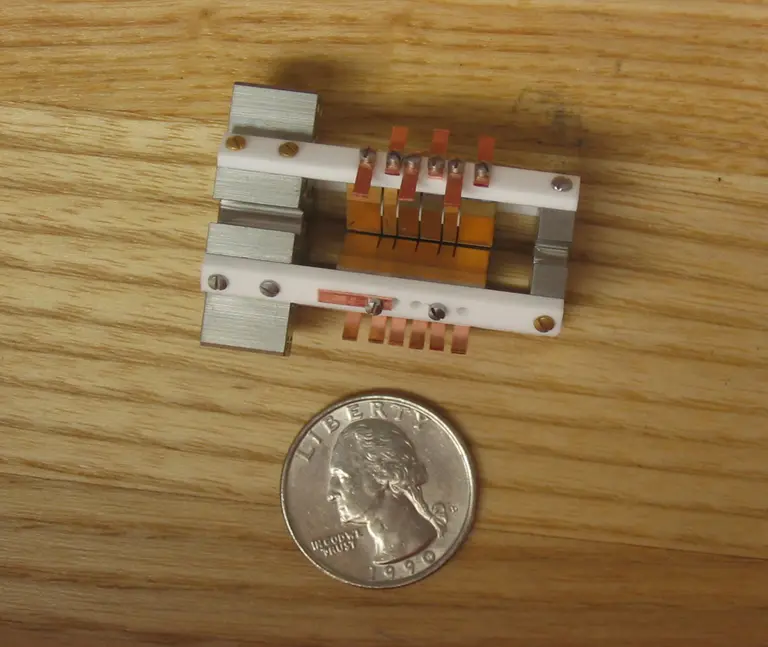
Laboratory photograph · aluminum-ion clock, 2010
A clock, down to its working parts. The ion trap at the heart of NIST’s aluminum-ion optical clock, photographed beside a U.S. quarter for scale. The trapped ion is not visible in this photograph.
Credit: J. Koelemeij/NIST · NIST reuse guidance · Full frame retained; resized and converted for web delivery
When a good clock becomes a map
Once you can measure a difference this small, a new question suggests itself. Instead of putting clocks at known heights and asking whether Einstein was right, could you use their disagreement to learn something about where they are?
This reverses the usual relationship between a clock and its surroundings. Normally, anything that makes a timekeeper run differently is an inconvenience. Here, the difference is information.
The quantity scientists want is called gravitational potential. Near the ground, moving a clock upward changes it in a predictable way. Across a wider landscape, however, the distribution of Earth’s mass matters too. A clock comparison measures a difference in potential, not simply a tape-measure distance. In 2018, NIST reported laboratory clock performance sensitive enough to support measurements corresponding to height differences of about a centimeter.6
That could help make better maps of the reference surface used to define level. The question is more useful than it first sounds: when water spreads across a landscape, where will it go?
Engineers and surveyors already work with Earth’s gravity to answer questions like this. Better measurements of gravitational potential could improve the reference surface against which heights are compared, helping people understand water’s path. Researchers also envision networks of clocks monitoring changes associated with underground water or other movements of mass. These are applications being developed, not services available from a watch on your wrist.7
Picture a future survey crew carrying a clock as part of its equipment. The aim would not be to arrive on time. By comparing its signal with a reference elsewhere, they could learn something about the terrain beneath them. The same effect that gives your upstairs neighbor an imperceptibly small head start could become a practical way to read the planet.
Getting the equipment out of its comfortable laboratory is a considerable part of that work.
For a field experiment reported in Nature Physics in 2018, a European team operated a transportable strontium clock in an underground laboratory reached through the Fréjus road tunnel, near the France–Italy border. They compared it with clocks in Turin, using an optical-fiber connection, to measure a difference in gravitational potential.8
“Transportable” did not mean something slipped into a backpack. Much of the apparatus occupied an air-conditioned car trailer. A particularly sensitive laser was placed outside the trailer, in the underground lab, to keep the air-conditioning vibrations from degrading its performance. The clock also suffered operating interruptions.8
That is a useful picture of technological progress: an instrument capable of testing the structure of time, with someone still needing to sort out where to put the air conditioner.
It also explains why a spectacular laboratory measurement is not the same as a ready-made global sensor network. Equipment has to travel, keep working, and exchange signals without the connection introducing errors that swamp the thing you want to measure. The future map depends on all of those jobs, not precision alone.
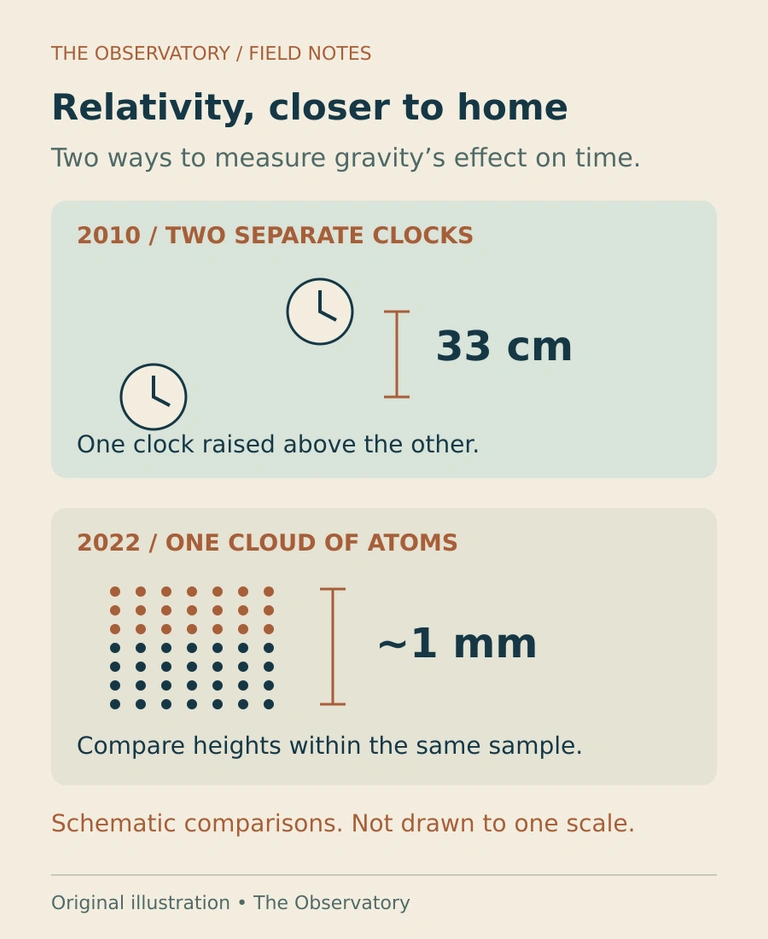
Conceptual explanatory illustration
Relativity at two experimental scales. In 2010, NIST compared separate atomic clocks separated in height by 33 centimeters. In 2022, JILA measured the effect across roughly a millimeter within one strontium sample. These schematic comparisons are not drawn to a common scale; dots do not show the actual atom count or measured data. Illustration by The Observatory.
Credit: The Observatory · original illustration created with AI assistance · Full image retained; schematic, not measured data
The universe between floors
There is already a less conspicuous place where different rates of time enter daily life. GPS satellites carry atomic clocks, and their timekeeping requires corrections for relativity. Their motion and their altitude affect the rates in opposite directions; the combined effect makes their clocks run faster than clocks on the ground. The navigation system accounts for that difference.3
So the strangeness is not waiting outside ordinary life until we decide to explore it. It is already involved when a phone helps someone find an unfamiliar street.
The newer clocks extend that intimacy. They let researchers ask questions about space and time within a little cloud of atoms, or use a difference in ticking to examine the Earth. Neither achievement gives us more hours in the day. There is no useful anti-aging strategy hidden in a basement lease.
What they offer is a different kind of access. A familiar place can contain a feature of reality that our senses have no hope of noticing, and we can still build something that notices it for us.
The next time you climb a staircase, you do not need to imagine leaving the everyday world behind. Keep the groceries balanced. Find your keys. The change in time is far too small to help with any of it.
It happens anyway.
Sources
Footnotes
NIST: Aluminum atomic clocks reveal relativity at a personal scale
NIST
2010
Scientific institution
In this article: Atomic clock comparison involving a 33-centimeter height difference.
Source 1NIST · 2010NIST: Aluminum atomic clocks reveal relativity at a personal scaleScientific institutionIn this articleAtomic clock comparison involving a 33-centimeter height differenceView source ↗Geodesy and metrology with a transportable optical clock
Jacopo Grotti and colleagues
Nature Physics · 2018
Primary research
In this article: Gravitational-potential and clock-frequency relationship underlying the explicitly illustrative calculation.
Source 2Jacopo Grotti and colleagues · 2018Geodesy and metrology with a transportable optical clockNature PhysicsPrimary researchIn this articleGravitational-potential and clock-frequency relationship underlying the explicitly illustrative calculationView source ↗NIST: Putting Einstein to the test
NIST
Scientific institution
In this article: Relativity, clock comparisons and GPS corrections.
Source 3NISTNIST: Putting Einstein to the testScientific institutionIn this articleRelativity, clock comparisons and GPS correctionsView source ↗NIST: How do atomic clocks work?
NIST
Scientific institution
In this article: Atomic transitions, laser tuning and timekeeping.
Source 4NISTNIST: How do atomic clocks work?Scientific institutionIn this articleAtomic transitions, laser tuning and timekeepingView source ↗NIST/JILA: Atomic clocks measure relativity at millimeter scale
NIST/JILA
2022
Scientific institution
In this article: Gravitational time dilation measured across a single strontium sample.
Source 5NIST/JILA · 2022NIST/JILA: Atomic clocks measure relativity at millimeter scaleScientific institutionIn this articleGravitational time dilation measured across a single strontium sampleView source ↗NIST: Atomic clocks keep time well enough to improve models of Earth
NIST
2018
Scientific institution
In this article: Laboratory clock performance and implications for relativistic geodesy.
Source 6NIST · 2018NIST: Atomic clocks keep time well enough to improve models of EarthScientific institutionIn this articleLaboratory clock performance and implications for relativistic geodesyView source ↗NIST: Mapping the Earth
NIST
Scientific institution
In this article: Geopotential surveying applications and practical field limitations.
Source 7NISTNIST: Mapping the EarthScientific institutionIn this articleGeopotential surveying applications and practical field limitationsView source ↗Geodesy and metrology with a transportable optical clock
Jacopo Grotti and colleagues
Nature Physics · 2018
Primary research
In this article: Transportable optical clock field experiment, optical link and operational constraints.
Source 8Jacopo Grotti and colleagues · 2018Geodesy and metrology with a transportable optical clockNature PhysicsPrimary researchIn this articleTransportable optical clock field experiment, optical link and operational constraintsView source ↗