What If We Could Sail to Another Star?
Sunlight has already pushed spacecraft through space. The larger dream is to send a tiny camera to a place no spacecraft has ever visited.
In 1976, Carl Sagan showed Johnny Carson a model of a spacecraft on late-night television. Its most memorable feature was a sail. Sagan was explaining how something that looked more at home on the sea could help us explore space, pushed along by sunlight.1
It was an appealingly strange proposition. We are used to light revealing the world: coming through a window, falling across a face, reaching us from a star. Sagan was asking people to consider it as something that could carry us toward a destination.
Not lift a ship off the ground. A rocket would still have work to do. But once a spacecraft was in space, with a large enough reflective sail and little enough mass, light could begin to push.
The idea has since produced actual flights. It has also led researchers toward a more audacious question. Could a distant star become somewhere we send a camera, rather than somewhere we point one?
Imagine the difference. A picture arriving from another star system would not be an artist’s interpretation of what might be there. Some small thing built on Earth would have crossed the gap, looked around, and sent something back. The landscape of space would have acquired a new point of view.
Getting that view may demand a spacecraft very unlike the enormous ships we tend to picture.
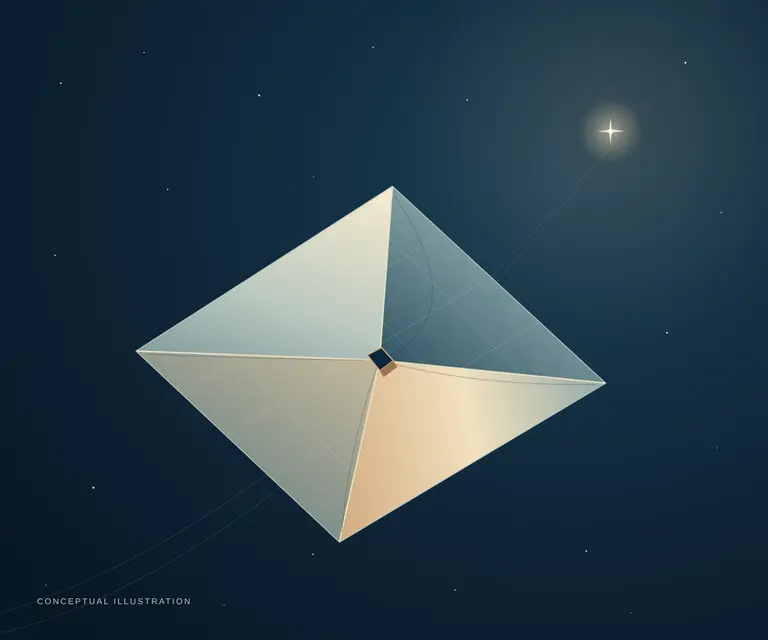
Conceptual editorial illustration
A sail toward the stars. An illustration of the possibility, not a mission photograph, engineering design, or representation of a demonstrated interstellar spacecraft.
Credit: The Observatory · original illustration created with AI assistance
The gentlest departure
A solar sail works because light carries momentum. When photons reflect from a surface, they give it a small push. This is not the solar wind, the stream of particles flowing from the Sun. It is the light itself.2
You do not feel yourself being driven backward when you step outside. The force is far too small for that. But give a lightweight spacecraft a broad reflective surface, and let the push accumulate, and something useful can happen. The appeal is persistence: while suitable light falls on the sail, there is no tank of propulsion fuel being steadily emptied to provide that force.
In 2010, the Japanese spacecraft IKAROS provided an unusually literal picture of the idea. After opening its sail, it released a small camera that drifted away and photographed the spacecraft. The camera could not come back. Its assignment was to give the people on Earth a view they could not get from aboard the ship itself.3
The images showed the sail spread out in space. Soon afterward, Japan’s space agency confirmed that sunlight was accelerating the craft.4 The claim that light could move a spacecraft had become something visible in its measured motion.
Nine years later, another sail unfolded above Earth. LightSail 2 belonged to The Planetary Society, the organization Sagan had helped found. Its reflective surface covered 32 square meters, attached to a small spacecraft. By changing its orientation during each orbit, it used sunlight to alter its path.5
There was no dramatic blast to watch. The accomplishment was in the careful turning, the accumulating push, and the measurements that showed it working.
The people making this happen included students. Michael Fernandez, then a physics undergraduate at Cal Poly San Luis Obispo, operated the spacecraft from a laptop during its brief passes within radio range. In the mission team’s account, he described an attachment that will be familiar to anyone who has spent too much time looking after a complicated project: “I think of LightSail 2 as my baby because I talk to it every day.”6
Roughly 50,000 people had contributed to the mission, alongside organizational supporters.7 It was a modest spacecraft with a remarkably large circle of people invested in whether it worked.
LightSail 2 eventually reentered the atmosphere in 2022. It had demonstrated controlled solar sailing, not escaped Earth or set off for the stars.5 But an idea once explained with a television prop had become something a college student could send instructions to as it passed overhead.
The question was no longer whether light could propel a spacecraft. It was how far that ability could take us.
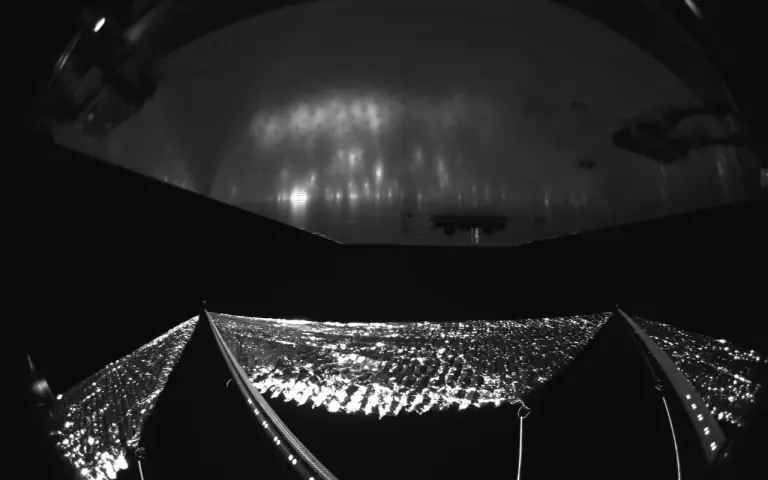
Onboard camera image · NASA ACS3, 2024
A real sail in space. NASA’s Advanced Composite Solar Sail System after deployment in 2024. The wide-angle camera distorts the apparent shapes of the booms and solar panel. This is a separate solar-sail mission, not IKAROS, LightSail, or a Starshot prototype.
Credit: NASA · NASA media-use guidance · Resized and converted for web delivery; full image retained
Leave the engine at home
There is a substantial catch in sailing toward another star: sunlight grows weaker as you move away from the Sun. A sail does not turn our star into an equally powerful engine at every distance.
The Breakthrough Starshot proposal takes a different approach. Instead of relying on the sunlight available along the route, it would use a powerful laser system on Earth to accelerate an extremely small probe attached to a sail. The proposed goal is around one-fifth the speed of light, enough for a flyby of the nearest star system in roughly two decades.89
That is a concept, not a demonstrated journey or a promised departure date. Its attraction is easy to grasp, though. Most of the equipment supplying the push would stay behind. The traveler would not have to haul the engine and its fuel all the way to another sun.
The proposed passenger would be instruments, not people. No cabin, no kitchen, no one watching a new star grow larger through a window. We would be sending our senses ahead of us, compressed into a machine small enough to be driven to an extraordinary speed.
At Caltech, physicist Harry Atwater has worked on what such a sail would need to survive. It must be very light, highly reflective, and stable under a powerful laser beam. Absorbing too much energy would heat it; drifting off the beam would spoil the launch. A material flimsy enough to accelerate efficiently still has to endure the force meant to propel it.9
That problem brings the imagined interstellar vessel down to a very small object on a laboratory bench.
In work reported in 2025, Caltech researchers Lior Michaeli, Ramon Gao, and their colleagues tested a miniature membrane suspended at its corners. They shone a laser on it and measured the motion caused by radiation pressure. Heating complicated the measurements, so the team had to distinguish the light’s direct push from the effects of warming the material.10
It was not a miniature spacecraft setting off across the room, much less a working interstellar sail. It was a way to investigate the material behavior on which a much larger ambition depends.
A photograph worth waiting for
One destination that gives the idea substance is Proxima Centauri, the nearest star to the Sun. A planet called Proxima b orbits there, about 4.25 light-years away. Whether it could support life remains unknown; even the survival of an atmosphere is a serious question because of the radiation from its star.11
So there is no established blue ocean waiting to be photographed. No verified landscape to put in the travel brochure. That uncertainty is part of the reason to want a closer look.
A successful mission could give us observations made from within another planetary system. Exactly what a tiny probe could capture and transmit would depend on the instruments, trajectory, and communications system. Starshot’s ambitions include images and other scientific measurements, but getting useful information home is itself one of the engineering problems.812
The proposed journey is a flyby. The probe would not arrive, slow down, and settle into a leisurely orbit to try again if the pictures were poor. Its speed is what makes the trip imaginable on a human timescale, and what makes the encounter difficult.
Then comes a final stretch of waiting. A message from Proxima’s neighborhood would need more than four years to reach Earth, even traveling at light speed. That delay follows directly from its distance.11
Suppose such a mission became possible. A child who watched the launch could be an adult when the first observations arrived. The spacecraft would travel while the rest of life continued: people moving house, choosing work, raising families, occasionally checking on the small machine somewhere beyond the familiar planets.
We could be there for the beginning and, perhaps, for the reply.
We do not know what such an image would show. It might be difficult to interpret, less beautiful than the illustrations that persuaded people to care, or surprising in ways the planners never anticipated. Its importance would not require it to resemble Earth.
An instrument built here would have looked out from beside another star. And now we would be seeing what it saw.
Sources
Footnotes
Bill Nye Honors Carl Sagan, Talks LightSail on “The Late Show with Stephen Colbert”
The Planetary Society
2017
Scientific institution
In this article: Sagan demonstrated a solar-sail model on television in 1976.
Source 1The Planetary Society · 2017Bill Nye Honors Carl Sagan, Talks LightSail on “The Late Show with Stephen Colbert”Scientific institutionIn this articleSagan demonstrated a solar-sail model on television in 1976.View source ↗Solar Sailing
NASA
Scientific institution
In this article: Photon pressure transfers momentum; solar sailing differs from solar wind.
Source 2NASASolar SailingScientific institutionIn this articlePhoton pressure transfers momentum; solar sailing differs from solar wind.View source ↗IKAROS: Successful Image Shooting by Separation Camera
JAXA
2010
Scientific institution
In this article: IKAROS photographed its deployed sail using a separation camera.
Source 3JAXA · 2010IKAROS: Successful Image Shooting by Separation CameraScientific institutionIn this articleIKAROS photographed its deployed sail using a separation camera.View source ↗IKAROS: Confirmation of Photon Acceleration
JAXA
2010
Scientific institution
In this article: JAXA confirmed photon acceleration of IKAROS.
Source 4JAXA · 2010IKAROS: Confirmation of Photon AccelerationScientific institutionIn this articleJAXA confirmed photon acceleration of IKAROS.View source ↗LightSail mission overview
The Planetary Society
Scientific institution
In this article: LightSail 2 deployed and steered its sail, changed its orbit and reentered in 2022.
Source 5The Planetary SocietyLightSail mission overviewScientific institutionIn this articleLightSail 2 deployed and steered its sail, changed its orbit and reentered in 2022.View source ↗LightSail 2 student operators
Jason Davis · The Planetary Society
Scientific institution
In this article: Student Michael Fernandez participated in LightSail 2 mission operations.
Source 6Jason Davis · The Planetary SocietyLightSail 2 student operatorsScientific institutionIn this articleStudent Michael Fernandez participated in LightSail 2 mission operations.View source ↗LightSail 2 Spacecraft Successfully Demonstrates Flight by Light
The Planetary Society
2019
Scientific institution
In this article: LightSail 2 demonstrated controlled solar sailing; donor participation.
Source 7The Planetary Society · 2019LightSail 2 Spacecraft Successfully Demonstrates Flight by LightScientific institutionIn this articleLightSail 2 demonstrated controlled solar sailing; donor participation.View source ↗Starshot
Breakthrough Initiatives
Scientific institution
In this article: Starshot proposes laser-driven tiny probes at a fraction of light speed; not a demonstrated mission.
Source 8Breakthrough InitiativesStarshotScientific institutionIn this articleStarshot proposes laser-driven tiny probes at a fraction of light speed; not a demonstrated mission.View source ↗Building the Starshot Sail: A Q&A with Harry Atwater
Caltech
2018
Scientific institution
In this article: Starshot sail engineering constraints including heat, acceleration and materials.
Source 9Caltech · 2018Building the Starshot Sail: A Q&A with Harry AtwaterScientific institutionIn this articleStarshot sail engineering constraints including heat, acceleration and materials.View source ↗The Pressure to Explore
Caltech
2025
Scientific institution
In this article: Tethered membrane experiments measured radiation pressure, not free-flight interstellar propulsion.
Source 10Caltech · 2025The Pressure to ExploreScientific institutionIn this articleTethered membrane experiments measured radiation pressure, not free-flight interstellar propulsion.View source ↗Our Nearest Celestial Neighbor? An Exotic 3-Star System
NASA
Scientific institution
In this article: Proxima distance and uncertainty about Proxima b; calculated signal delay.
Source 11NASAOur Nearest Celestial Neighbor? An Exotic 3-Star SystemScientific institutionIn this articleProxima distance and uncertainty about Proxima b; calculated signal delay.View source ↗Starshot engineering challenges
Breakthrough Initiatives
Scientific institution
In this article: Starshot communications and other unsolved mission engineering challenges.
Source 12Breakthrough InitiativesStarshot engineering challengesScientific institutionIn this articleStarshot communications and other unsolved mission engineering challenges.View source ↗