An Ocean Beneath the Ice, a Poem on the Way
Europa Clipper carries a few things that cannot help it navigate: a poem, millions of names, and the word “water” in 103 languages. Its destination might change how we imagine a living world.
Before sending a spacecraft to Jupiter, people made room for a poet’s handwriting.
Ada Limón’s poem was engraved on a metal plate for NASA’s Europa Clipper. Nearby, a silicon chip held more than 2.6 million names submitted by the public. On the other side of the plate, recordings of people saying “water” in 103 languages became etched waveforms, arranged around a symbol for the word in American Sign Language.1
There are more practical things to pack for such a journey. But practicality does not entirely explain why anyone would build a spacecraft to investigate an ocean they cannot see.
You can understand the choice of word without knowing much about Jupiter. Water is something you ask for at a restaurant, run over a scraped knee, look for when you wake thirsty in the night. Here it becomes the connection to a moon so unfamiliar that its sea, if we could reach it, would have a ceiling.
Europa Clipper launched on October 14, 2024. Its planned arrival at Jupiter is in 2030. It is going to investigate whether Europa, one of Jupiter’s moons, has environments that could support life.2
That leaves room for a remarkable result without requiring a discovery of aliens. We may learn that a world very unlike ours has some of the qualities that make ours a home.
Conceptual explanatory illustration
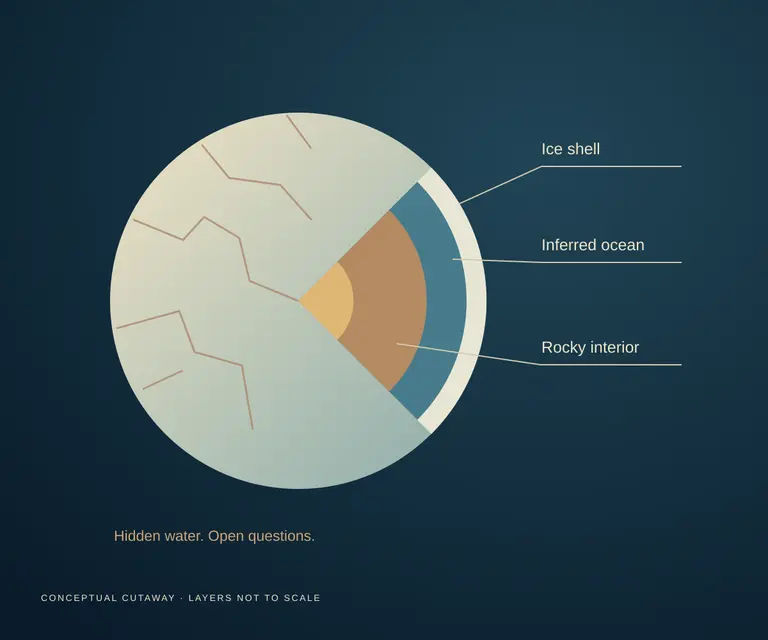
An ocean inferred beneath the ice. An icy surface may hide a global ocean. This conceptual cutaway shows Europa's inferred layers, not a direct view beneath the ice. Illustration by The Observatory; thicknesses are not to scale.
Credit: The Observatory · original illustration created with AI assistance · Full image retained; responsive web delivery
A sea without a shore
Picture an ocean, and you probably supply more than water. A horizon. Weather. Light moving across the surface. Somewhere, perhaps, a place to stand with your shoes off.
Europa takes almost all of that away.
Scientists think its ocean lies under a shell of ice roughly 15 to 25 kilometers thick. The sea beneath could be 60 to 150 kilometers deep. Those are estimates, not measurements from a submarine, but they describe something much larger than a pocket of meltwater: a global ocean that may hold about twice the water in Earth’s oceans.3
No one has looked through a hole and seen it. One of the strongest clues came from NASA’s Galileo spacecraft, which detected a magnetic response from Europa as Jupiter’s magnetic field swept past. A deep, electrically conducting layer could produce that response. Given what Europa is made of, a salty ocean is the leading explanation.3
It is a wonderfully indirect way to find a sea. You cannot see the water, so you look for what it does to something that passes through it.
The same giant planet that makes that measurement possible also helps explain how water could remain liquid there. Jupiter’s gravity stretches and relaxes Europa as the moon travels around it. That repeated flexing generates internal heat, likely helping sustain the ocean beneath the frozen exterior.4
The result asks us to loosen an old association. A place need not look welcoming from the outside to contain an environment worth investigating. A frozen surface can conceal a warmer interior. Distance from the Sun does not tell the whole story.
For anyone who has imagined finding life by looking for another blue Earth, Europa offers a different starting point. We might need to look beneath a world rather than across it.
Learning to look through ice
Of course, “beneath” is a difficult destination when there are kilometers of ice in the way. Clipper is not carrying a submarine or preparing to drill a shaft. It will study Europa during repeated flybys, gathering evidence from above.2
Some of the skills needed for this work come from people trying to understand ice much closer to home.
In a NASA account of the mission’s radar team, a photograph shows Dustin Schroeder as a graduate student in 2009, monitoring a computer console aboard an aircraft over Antarctica. He would go on to become a member of Clipper’s radar investigation. Ice-penetrating radar has been used for decades to study Earth’s glaciers and ice sheets, including the landscapes and water hidden beneath them.5
So part of the preparation for an ocean moon happens over our own frozen continent. The unfamiliar destination depends on a familiar scientific habit: learn what an instrument tells you somewhere you can check, then see how far that knowledge will travel.
Clipper’s radar will send radio waves into Europa’s ice and study the returning echoes. Boundaries within the shell can reflect those waves, helping researchers investigate its structure and search for water. The instrument’s ambition includes looking for the boundary between ice and ocean, though reaching that boundary is not guaranteed.6
It will not send back the underwater equivalent of a holiday photograph. Someone will have to read a signal, compare it with other measurements, and work out which explanation survives.
That makes the thickness and structure of ice more than dry specifications. Researchers want to understand whether the shell is a barrier or also a route: can material move between the exposed surface and the water below? A sea sealed away from useful chemistry might be a very different place from one regularly supplied with it.5
The ice is part of the question about life, not merely the packaging scientists wish they could remove.
Conceptual explanatory illustration
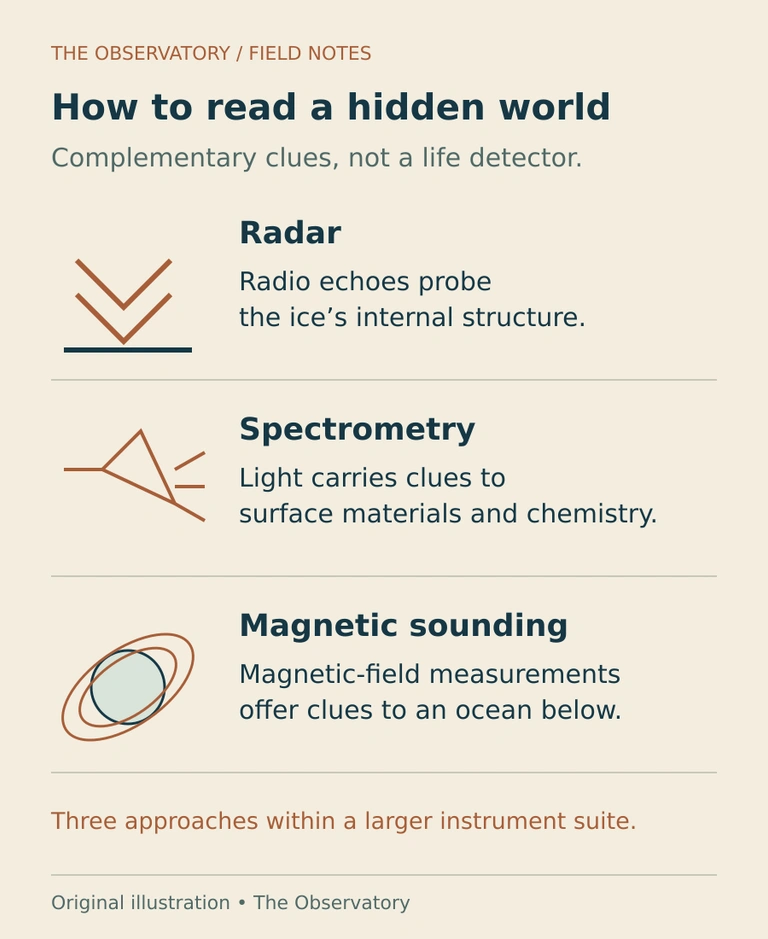
Reading a hidden world. Europa Clipper combines several kinds of clues: radar echoes from ice, spectral signatures of surface materials and magnetic measurements that can constrain an ocean beneath. These are three approaches within a larger instrument suite, not a life-detection system. Icons are conceptual, not instrument designs. Illustration by The Observatory.
Credit: The Observatory · original illustration created with AI assistance · Full image retained; schematic, not measured data
What a living ocean would need
Water is a promising beginning. It is not a complete address for life.
Living things also need suitable chemistry and a usable supply of energy. Under Europa’s ice, sunlight would not be available to power photosynthesis. If life exists there, researchers expect it would draw energy from chemical reactions. Interactions between water and a rocky seafloor are one possible source. Hydrothermal systems on Earth show that this kind of energy supply is possible; comparable vents on Europa remain a possibility, not an observed feature.4
This is where the imagined scene can run ahead of the evidence. Once someone says “alien ocean,” it is easy to furnish it. Something swimming. Something glowing. Something looking back.
For now, we do not know whether anything lives there at all.
NASA explicitly describes Clipper as a mission to assess habitability, not a life-detection mission.2 The distinction is less frustrating if you think about what it would take to plan the next journey. Before choosing where and how to search for organisms, you want a much better understanding of the place you are searching.
Clipper carries instruments that will map surface materials and examine the chemical makeup of gas and dust around the moon. Other measurements will help researchers investigate the ocean’s properties. No single instrument supplies the whole account; the work is to bring different kinds of evidence into agreement.6
Even finding organic molecules would not settle the question. “Organic” describes carbon-based chemistry, not a certificate that something was alive. Such molecules can form without organisms.4
But a map showing where promising materials occur would give a future investigator something more useful than a general feeling that Europa is interesting. It could help turn an entire moon into particular places worth a closer look.
Mission image · Galileo natural-color mosaic
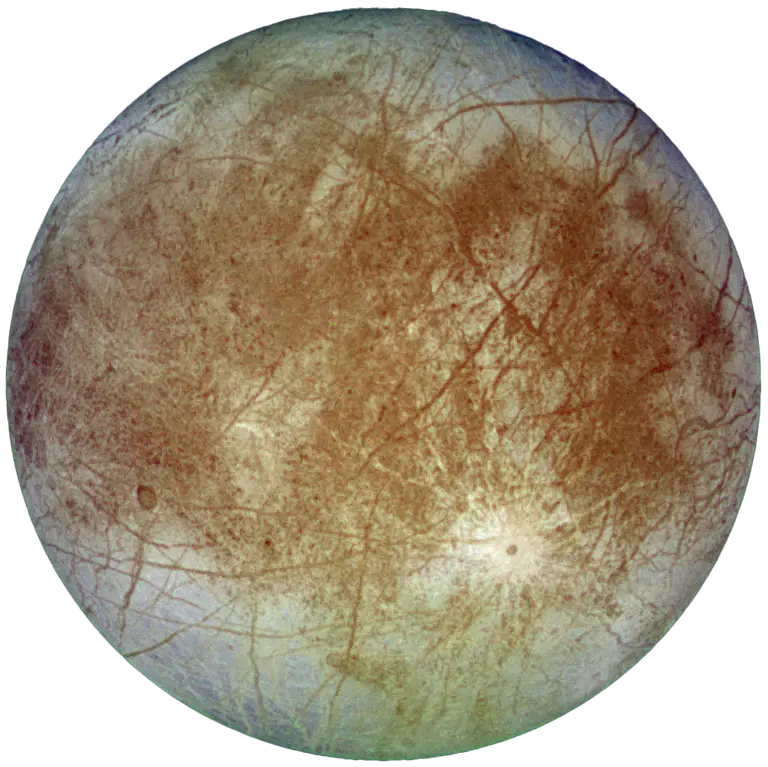
The surface we can see. An approximately natural-color view assembled from Galileo observations on September 7, 1996. This is Europa’s icy surface, not a view of the ocean beneath it or an image from Europa Clipper.
Credit: NASA/JPL/DLR, via USGS · Public domain · USGS source record · Full frame retained; resized and converted for web delivery
Close enough to learn, far enough to survive
Getting those measurements requires a slightly counterintuitive flight plan. Europa Clipper will orbit Jupiter, rather than settle into orbit around Europa itself.
The moon sits in an intense radiation environment. Repeatedly passing through for observations, then traveling away, gives the spacecraft a better chance of surviving years of work than lingering beside Europa would.2 The planned survey includes nearly 50 close flybys, over different parts of the moon, some as low as about 25 kilometers above the surface.7
There is something recognizable in that compromise. Even a mission sent to investigate one of the grandest questions has to arrange its working day around protecting the equipment.
Those brief encounters could gradually replace a distant, intriguing object with a more particular world: regions with different materials, structures within its ice, clues to how its interior and surface communicate. Researchers will have to decide which patterns belong together and which apparent connections were wishful thinking.
A successful mission could still leave the question of life unanswered. It could also make the next version of that question much sharper. Where might the ocean exchange material with the surface? Which observations would be most useful to repeat? What would another spacecraft need to measure that this one could not?
The poem and the names are traveling alongside the instruments that will help us ask. Their readers, for the foreseeable future, are here on Earth.
You can send your name farther than you will ever travel and still wait for something quite ordinary in return: news of a place you have become interested in. In this case, the news might concern a crack in the ice, an unexpected chemical, a radar echo that takes months to understand.
Somewhere beneath that ice may be a sea larger than all our oceans put together. We have built a way to learn more about it. The first good answer need not be the last one.
Sources
Footnotes
NASA Unveils Design for Message Heading to Jupiter’s Moon Europa
NASA/JPL
2024
Scientific institution
In this article: Message plate design, handwritten poem and public participation.
Source 1NASA/JPL · 2024NASA Unveils Design for Message Heading to Jupiter’s Moon EuropaScientific institutionIn this articleMessage plate design, handwritten poem and public participationView source ↗Europa Clipper Mission FAQ
NASA
Scientific institution
In this article: Mission schedule, flybys and habitability investigation rather than life detection.
Source 2NASAEuropa Clipper Mission FAQScientific institutionIn this articleMission schedule, flybys and habitability investigation rather than life detectionView source ↗Europa Facts
NASA
Scientific institution
In this article: Estimated shell and ocean dimensions and Galileo magnetic evidence.
Source 3NASAEuropa FactsScientific institutionIn this articleEstimated shell and ocean dimensions and Galileo magnetic evidenceView source ↗Why Europa: Ingredients for Life
NASA
Scientific institution
In this article: Tidal heating, chemistry and possible energy sources without establishing life.
Source 4NASAWhy Europa: Ingredients for LifeScientific institutionIn this articleTidal heating, chemistry and possible energy sources without establishing lifeView source ↗Mission Dispatch: Using Radar to Study Earth and Europa
NASA
Scientific institution
In this article: Schroeder’s documented Antarctic fieldwork and terrestrial ice radar.
Source 5NASAMission Dispatch: Using Radar to Study Earth and EuropaScientific institutionIn this articleSchroeder’s documented Antarctic fieldwork and terrestrial ice radarView source ↗Europa Clipper Spacecraft Instruments
NASA
Scientific institution
In this article: Complementary spacecraft instruments and measurements.
Source 6NASAEuropa Clipper Spacecraft InstrumentsScientific institutionIn this articleComplementary spacecraft instruments and measurementsView source ↗Europa Clipper Mission Overview
NASA
Scientific institution
In this article: Planned flyby survey, altitude and mission objectives.
Source 7NASAEuropa Clipper Mission OverviewScientific institutionIn this articlePlanned flyby survey, altitude and mission objectivesView source ↗