Would an Extra Thumb Eventually Feel Like Yours?
A robotic finger can be surprisingly easy to operate. The more intriguing question is what happens when you stop thinking about operating it.
When science broadcaster Chris Smith went to try an extra thumb, the first thing designer Dani Clode asked him to do was take off his shoes.
Smith joked about his socks, then asked why a demonstration for his hand required his shoes off. But Clode’s Third Thumb takes its instructions from the feet. In the recorded interview, Smith pressed his big toes and watched the addition to his hand move. Before long, he was attempting to hold his microphone with it.1
Consider the small rearrangement involved. Something you do inside your sock makes something beside your little finger curl. Meanwhile, the fingers you arrived with are still there, available for work. You haven’t exchanged your hand for a machine. You have given it an unfamiliar colleague.
The obvious question is what you could do with an extra digit. Hold something steady while adjusting it? Carry the awkward object that usually defeats your grip? The stranger question arrives a little later: after enough practice, would reaching with it begin to feel like something you do, rather than something you tell a device to do?
There are already hints that it could. They are more intimate, and less conclusive, than the announcement that humans are ready for extra limbs.
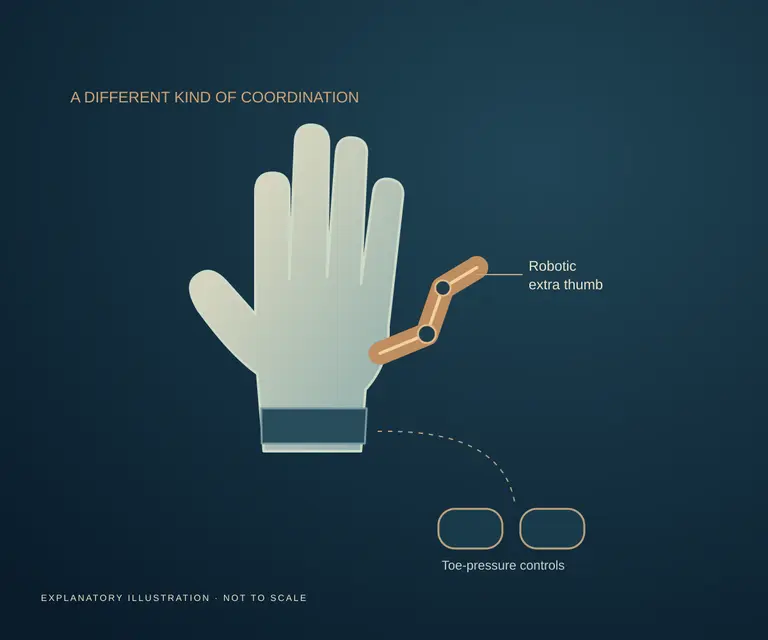
Conceptual explanatory illustration
A hand with another possibility. The Third Thumb adds a robotic digit opposite the natural thumb. In the toe-controlled setup, pressure sensors beneath the feet control its movement. Simplified illustration by The Observatory, not an exact device drawing.
Credit: The Observatory · original illustration created with AI assistance · Full image retained; responsive web delivery
A hand with another possibility
Clode began developing the Third Thumb as a graduate design project at the Royal College of Art. Her aim was to explore prosthetics as an extension of what a body can do, rather than only a replacement for something missing. The project eventually brought her into neuroscientist Tamar Makin’s research team at UCL.2
The device adds a second thumb to one hand, making three across the body. It sits opposite the natural thumb, beside the little finger. Pressure beneath the big toes controls two directions of movement: across the palm and toward the fingers. The wearer supplies the coordination.3
For Smith, holding the microphone raised another problem: now what? Clode pointed out that the extra thumb could hold an object while leaving his ordinary fingers available. She offered a bottle as an example: secure it with the added digit and use the same hand to unscrew the cap.1
Try imagining that action rather than simply counting to six. One part of the hand steadies; another turns. The useful addition is a new relationship between movements.
That distinction also makes the device harder to evaluate than a stronger motor. An extra finger could be beautifully engineered and still demand so much concentration that you would rather put the bottle down. The person has to learn a way of working in which the extra machinery earns its place.
At the Royal Society’s Summer Science Exhibition in 2022, researchers tested the Third Thumb with 596 visitors aged three to 96. Participants received up to a minute to become familiar with it, followed by a one-minute object-moving task. Some moved pegs with the robotic thumb alone; others used it alongside their biological fingers to move foam objects. The study, published in 2024, reported that 98 percent could manipulate objects successfully.4
This was an encouraging first encounter, not a trial of life with an upgraded hand. The youngest children had more difficulty, and a few participants could not securely wear or control the device. A minute at an exhibition cannot tell you whether someone would want to wear it through a working day.4
But the invitation was remarkably broad. You did not need years of preparation before you could begin finding out what this unfamiliar arrangement allowed.
When the instructions recede
An earlier experiment gave people longer to learn. Twenty participants trained with the Third Thumb over five days and were encouraged to take it home. In laboratory tasks, they practiced coordinating it with their hands, including handling multiple objects. They could also build a block tower while doing arithmetic, and perform a coordination task without seeing their hand.2
Having to watch every movement would compete with whatever you were trying to accomplish. The blindfold result suggests a way past that inconvenience. It does not give the device the sensory life of a biological finger.
The researchers also asked participants how the thumb felt to them. After training, people reported greater feelings of control and bodily ownership. Yet measurements of their perception of their own hand did not show a corresponding clear transformation. In the training tasks, participants without an active extra thumb were often more efficient; additional machinery was not an automatic advantage.3
So the answer depends partly on what you mean by “yours.” You can own a bicycle, become very good at riding it, and still experience it as something you ride. An added finger invites a closer sort of familiarity. It joins the same small workspace as the fingers that button your shirt or turn a page.
Learning its controls and feeling it belongs to you are related possibilities, but one does not settle the other. Nor does reporting a stronger feeling of ownership after five days tell us what that feeling would become after five years.
Brain scans offered another clue. After training, the activity patterns associated with moving the biological fingers were less distinct from one another.2 This was a change in the existing hand’s representation, not evidence that a new finger had fully taken its place in the brain.
For a future wearer, that leaves a practical question beneath the philosophical one: can you gain a useful new movement without making familiar movements harder? The aim would be to leave the experiment with more freedom, including the freedom to take the device off.
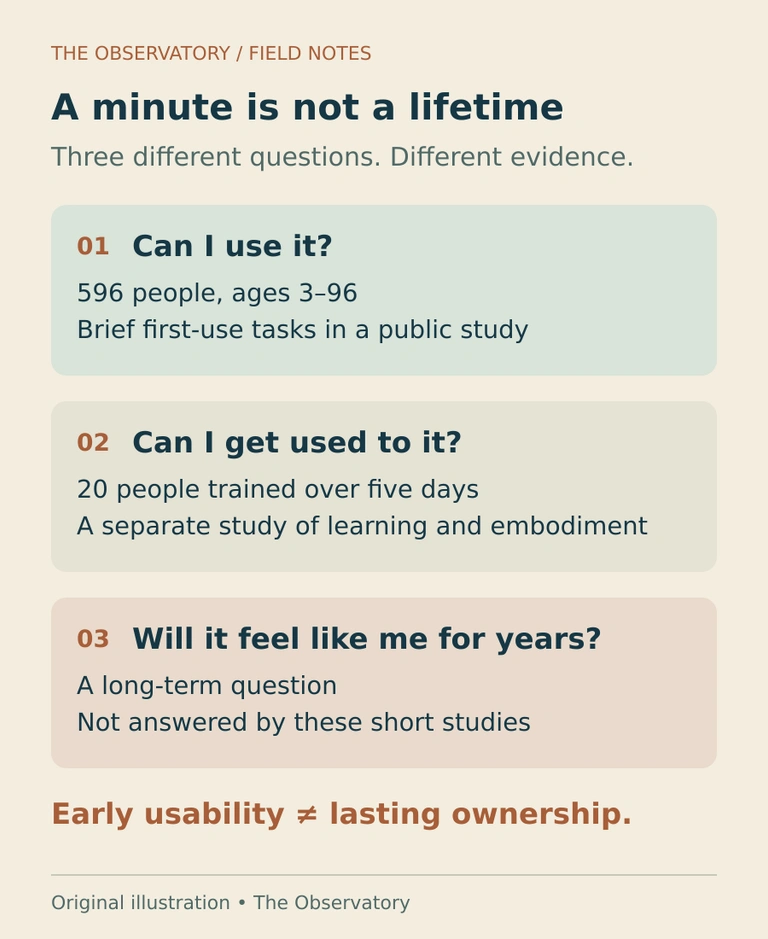
Conceptual explanatory illustration
Different questions, different evidence. Initial usability and lasting bodily ownership are different questions. The public-use study tested 596 people aged 3–96; a separate study trained 20 people over five days. Neither establishes how an added digit would feel over years. Illustration by The Observatory.
Credit: The Observatory · original illustration created with AI assistance · Full image retained; schematic, not measured data
What would you make with it?
There is another place where an extra finger has already been invited to contribute: a piano.
In separate research at Imperial College London, a pianist tried a different robotic thumb and incorporated it into playing within an hour. A subsequent experiment involved six experienced players and six novices learning a simple sequence with a foot-controlled extra digit. The added reach let the right hand cover notes that otherwise required help from the left. Performance with the robot was less accurate than using the biological finger it substituted for in the task.5
Nobody had demonstrated an instant concert pianist. But the experiment opened a question more appealing than whether we could all become slightly more efficient at carrying things.
Suppose a musician had a reliable extra digit and time to explore it. Which movements would they discover? Would they use the additional reach to make familiar music easier, or begin writing something that felt awkward with the old arrangement?
Those are possibilities, not results of the piano study. An instrument, a player and a new set of movements would have to find their way together. There could be awkward practice sessions, abandoned experiments and techniques worth passing on. The extra finger itself would not supply the imagination.
It might also turn out to be useful only occasionally. A musician could wear an augmentation for one piece, a maker for one delicate job. A successful future for these devices need not involve everyone acquiring permanent new anatomy. It could involve more choices about how to approach the things we love doing.
And familiarity need not arrive as a dramatic revelation. Imagine a future wearer working on a small object: holding, turning, adjusting. At first, their attention keeps returning to the unfamiliar digit. Eventually, perhaps, they become absorbed in what they are making.
We do not yet know how far that transition can go, or for whom. A few days of experiments cannot establish a lifelong addition to the sense of self.
Still, there is a lovely possibility here. A piece of technology might become useful enough, and familiar enough, that its most impressive moment is no longer the moment someone notices it.
It is the moment they get on with making something.
Sources
Footnotes
How does a person get to grips with an extra thumb?
Chris Smith · The Naked Scientists
2024
Historical primary source
In this article: Recorded interview, documented demonstration and examples described by the interviewees.
Source 1Chris Smith · The Naked Scientists · 2024How does a person get to grips with an extra thumb?Historical primary sourceIn this articleRecorded interview, documented demonstration and examples described by the intervieweesView source ↗Robotic ‘Third Thumb’ use can alter brain representation of the hand
UCL
2021
Secondary source
In this article: Design background, collaboration and the training experiment.
Source 2UCL · 2021Robotic ‘Third Thumb’ use can alter brain representation of the handSecondary sourceIn this articleDesign background, collaboration and the training experimentView source ↗Robotic hand augmentation drives changes in neural body representation
Paulina Kieliba; Danielle Clode; Roni O. Maimon-Mor; Tamar R. Makin
Science Robotics · 2021
Primary research
In this article: Short-term training, embodiment and neural representation findings.
Source 3Paulina Kieliba et al. · 2021Robotic hand augmentation drives changes in neural body representationScience RoboticsPrimary researchIn this articleShort-term training, embodiment and neural representation findingsView source ↗Evaluating initial usability of a hand augmentation device across a large and diverse sample
Dani Clode; Lucy Dowdall and colleagues
Science Robotics · 2024
Primary research
In this article: Initial usability study, sample, protocol and age-related limitations.
Source 4Dani Clode et al. · 2024Evaluating initial usability of a hand augmentation device across a large and diverse sampleScience RoboticsPrimary researchIn this articleInitial usability study, sample, protocol and age-related limitationsView source ↗Playing the piano with a robotic third thumb: assessing constraints of human augmentation
Ali Shafti; Shlomi Haar; Renato Mio; Pierre Guilleminot; A. Aldo Faisal
Scientific Reports · 2021
Primary research
In this article: Separate robotic-thumb piano experiment and distinction between pilot and sequence task.
Source 5Ali Shafti et al. · 2021Playing the piano with a robotic third thumb: assessing constraints of human augmentationScientific ReportsPrimary researchIn this articleSeparate robotic-thumb piano experiment and distinction between pilot and sequence taskView source ↗