Voyager and the Long Way Out
Our most distant spacecraft has reached interstellar space. The surprising part is how much of home still lies ahead.
Voyager 1 needed a little over three years to reach Saturn. Nearly thirty-two years after Saturn, it crossed into interstellar space. By then, a mission that began with photographs of giant planets had occupied almost an entire working life.1
And it still had not passed beyond everything that belongs to the solar system.
NASA launched Voyager 1 in September 1977, one of two uncrewed probes sent to investigate the outer planets. Jupiter came in 1979; Saturn in 1980. After Saturn, Voyager headed away from the plane where the planets orbit, leaving the close encounters behind.1
That is where a familiar picture of space starts to become unhelpful. A solar-system diagram gives us a bright Sun, a sequence of planets and, somewhere near the margin, permission to stop thinking. Voyager kept going past the part that fits comfortably on the page.
In 2012, it crossed the boundary of the huge bubble created by the Sun’s outward-flowing wind. Beyond that boundary lay interstellar space. Yet much farther out, astronomers expect a vast population of icy bodies still orbiting our star. Voyager will need centuries just to reach that region.2
We have sent something an extraordinary distance. To appreciate the achievement, though, we have to make room for a stranger thought: the place we are leaving is much larger than the place we imagined.
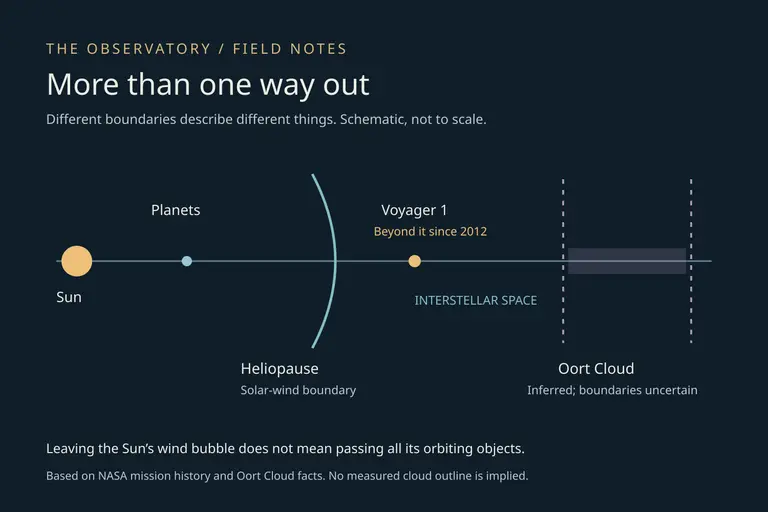
Original explanatory diagram · Not to scale
More than one way out. Voyager crossed the heliopause in 2012. The inferred Oort Cloud lies far beyond that boundary. The drawing separates physical ideas, not measured distances or a directly observed cloud.
Credit: The Observatory / jdot
There is more than one way out
The Sun does not end at the bright surface we see. It releases a stream of charged particles, the solar wind, which expands into surrounding interstellar material. The region dominated by that outflow is called the heliosphere; its outer boundary is the heliopause.3
Crossing it means entering a different physical environment. It does not mean the Sun’s gravity suddenly stops.
That distinction leaves room for the Oort Cloud: a proposed, roughly spherical reservoir of icy objects far beyond the planets. The cloud has not been directly observed. Its existence is inferred from evidence including the orbits of long-period comets, which approach the inner solar system from many directions.2
NASA places its possible inner edge thousands of times farther from the Sun than Earth is, with an outer extent that remains highly uncertain. At Voyager’s pace, the agency estimates hundreds of years to reach the cloud and perhaps tens of thousands to travel beyond it. These are rough forecasts through a poorly mapped region, not dates on a flight schedule.2
So “outside the solar system” depends on what you mean by the system. Outside the Sun’s wind bubble? Voyager has done that. Beyond its distant population of orbiting bodies? Not remotely.
Neither border is painted on space. Even determining that Voyager had crossed the first one took some detective work.
The crossing nobody could simply see
The spacecraft entered interstellar space in August 2012. NASA announced the conclusion in September 2013.4
The delay was not just the time a radio signal needed to reach Earth. Researchers had to establish what the measurements meant, and an instrument that could have helped was no longer working. Voyager’s plasma sensor could not directly measure the surrounding gas of charged particles.
Then the Sun provided an unexpected opportunity. A major eruption in March 2012 sent a disturbance outward. When it reached Voyager in April 2013, the surrounding plasma oscillated. A different instrument could detect those oscillations, whose frequency revealed the plasma’s density.
The result indicated an environment more than forty times denser than the plasma in the outer heliosphere. Reviewing earlier, weaker oscillations helped the team trace the transition back to August 2012, consistent with changes seen in energetic particles.4
The confirmation of Voyager’s departure had arrived with help from the star it was leaving.
This is the less familiar kind of exploration that followed the planetary photographs. There was no new landscape to frame. There were signals to interpret, competing possibilities to eliminate, and a spacecraft carrying instruments into material that had never been sampled there before.
A day away, and barely anywhere
By late 2026, Voyager’s distance from Earth was approaching a milestone NASA had projected for November 18: one light-day. A radio signal would need a full day to cross the gap in one direction.5
Try holding that beside the age of the spacecraft. Nearly half a century of travel, traversed by light in twenty-four hours.
Now consider the nearest star beyond the Sun, Proxima Centauri, a little over four light-years away. One light-day is only about one-fifteen-hundredth of that distance. This is a comparison of scales, not a progress bar: Voyager is not headed toward Proxima.6
Widen the view again. The Milky Way’s stellar disk spans roughly 100,000 light-years. On a diagram that shrinks that diameter to one meter, a one-light-day separation becomes about twenty-seven nanometers, far below what an unaided eye could distinguish.7
Earth and Voyager would occupy the same apparent point.
That is the answer to how far Voyager has made it across the galaxy: on a galactic map, it has barely separated from us. On the scale of the wider universe, the journey is smaller still. There is no sensible percentage of “the universe” to count off, and Voyager is not attempting to leave the Milky Way.
But a galaxy-wide map also hides the very thing the mission is doing. A distance too small to draw at that scale can contain a profound change of environment. Voyager does not need to reach another star to encounter something we cannot reproduce by looking at one.
In 2021, Stella Ocker and colleagues reported a faint, persistent emission in its plasma-wave measurements. It allowed them to follow variations in interstellar plasma density between the stronger disturbances scientists had previously relied upon. The fluctuations traced turbulence across a stretch of the spacecraft’s journey.8
The space between stars was becoming a place with measurable texture.
Keeping a small opening open
That makes a failed computer more consequential than a broken piece of old hardware.
In November 2023, Voyager 1 stopped returning usable science and engineering data. It could still receive commands and transmit a signal, but a damaged memory chip in the computer that packaged its data had left the team unable to read what it sent.9
No rescue mission could carry a replacement. The engineers had to make the surviving computer work differently.
They found unused memory, but no single available area could hold all the affected code. They split it into pieces, moved those pieces and changed the references that connected them. In a later public discussion, repair-team member Dave Cummings explained another difficulty: the team no longer had a Voyager test platform or simulator, or the usual tools for translating software into machine instructions. They converted the changes into binary manually and repeatedly examined them against a detailed checklist.10
The repair was transmitted on April 18, 2024. Readable engineering data arrived back on April 20. At the time, each leg of the radio journey took about twenty-two and a half hours.9
In a photograph from that morning, the team is applauding around a conference table crowded with laptops and breakfast. One man has both fists raised.11
They had reopened a connection to somewhere no replacement instrument was waiting.
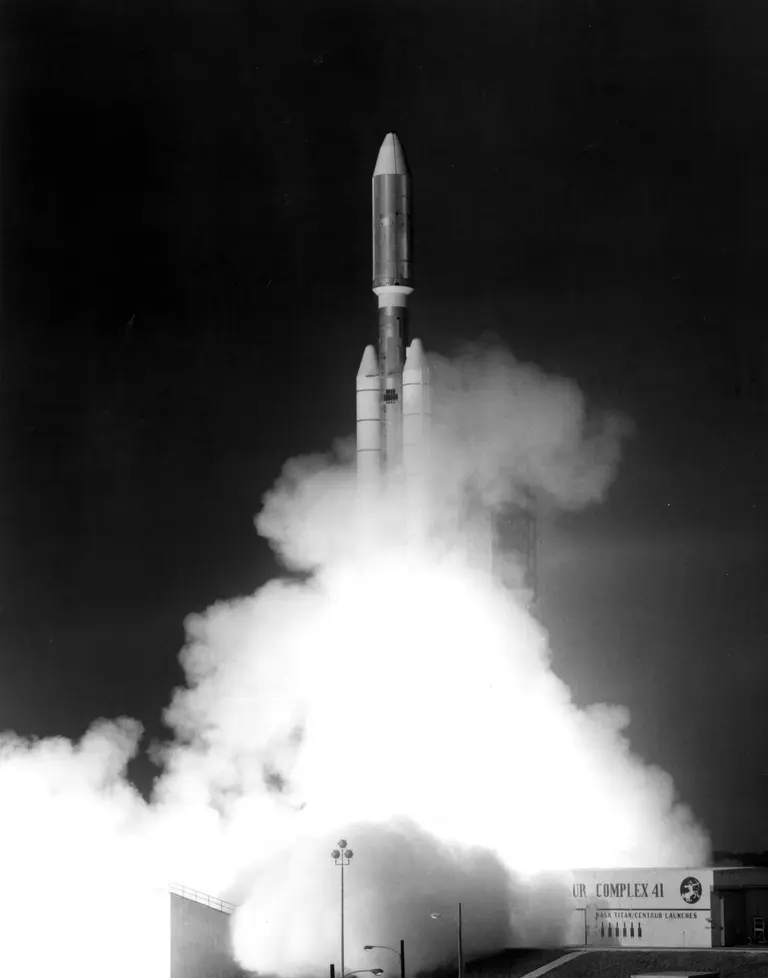
Archival photograph · September 5, 1977
The beginning of the long way out. Voyager 1 leaves Earth in 1977. Its original planetary encounters would become the beginning of a much longer scientific journey.
Credit: NASA/KSC · JPL image-use policy · Resized
What comes after the first traveler?
Voyager makes the distances daunting. It also makes the next question more precise. Must the next mission reach another star to be worth sending?
A team led at the Johns Hopkins Applied Physics Laboratory explored a different ambition in its Interstellar Probe study. A 2023 paper described a spacecraft designed for a fifty-year mission, reaching roughly 375 astronomical units, or 375 times Earth’s distance from the Sun. The proposal aimed to investigate the Sun’s interaction with its surroundings and sample interstellar material farther beyond the disturbed boundary region.12
That is a mission concept, not a promised launch. It is also a revealing choice of destination. The scientific opportunity does not begin thousands of years down the road, near another sun. It begins in the enormous, incompletely understood region around our own.
Such a mission would make succession part of exploration. Someone joining near launch could spend a career on the project without seeing its final measurements. The question would be not only how to build a durable spacecraft, but how to preserve the knowledge needed to operate it when the original team is gone.
Voyager already offers a practical version of that problem. Its engineers have described relying on thousands of pages of original, typewritten documentation, now scanned for continued use.10 A record of how a machine works can become as necessary to a distant discovery as the machine itself.
In February 1990, Voyager 1 turned its camera toward Earth and took the image we call the Pale Blue Dot. Our planet appears as a tiny speck in scattered sunlight.13 It is an unsettling picture because almost everything that feels large in a human life is compressed into something you could easily overlook.
The outward view asks for a different adjustment. Past the planets, past the wind bubble, past the distant comets, the map keeps opening.
Voyager has not made those distances small. It has made one thin route through them real: a chain of measurements, commands and replies connecting a room on Earth to a place beyond the Sun’s wind. Another mission could follow a different route, carrying questions the first travelers taught us to ask.
We are still learning the dimensions of home.
Sources
Footnotes
Voyager 1 mission history
NASA
Scientific institution
In this article: Claims cited in the article; see source note for scope and limitations.
Source 1NASAVoyager 1 mission historyScientific institutionIn this articleClaims cited in the article; see source note for scope and limitations.View source ↗Oort Cloud Facts
NASA
2025
Scientific institution
In this article: Claims cited in the article; see source note for scope and limitations.
Source 2NASA · 2025Oort Cloud FactsScientific institutionIn this articleClaims cited in the article; see source note for scope and limitations.View source ↗Voyager frequently asked questions
NASA
Scientific institution
In this article: Claims cited in the article; see source note for scope and limitations.
Source 3NASAVoyager frequently asked questionsScientific institutionIn this articleClaims cited in the article; see source note for scope and limitations.View source ↗Spacecraft Embarks on Historic Journey into Interstellar Space
NASA
2013
Scientific institution
In this article: Claims cited in the article; see source note for scope and limitations.
Source 4NASA · 2013Spacecraft Embarks on Historic Journey into Interstellar SpaceScientific institutionIn this articleClaims cited in the article; see source note for scope and limitations.View source ↗Voyager 1 Conserves Power, Resolves Brief Communications Pause
NASA
2026
Scientific institution
In this article: Claims cited in the article; see source note for scope and limitations.
Source 5NASA · 2026Voyager 1 Conserves Power, Resolves Brief Communications PauseScientific institutionIn this articleClaims cited in the article; see source note for scope and limitations.View source ↗Our Milky Way Galaxy: How Big Is Space?
NASA
Scientific institution
In this article: Claims cited in the article; see source note for scope and limitations.
Source 6NASAOur Milky Way Galaxy: How Big Is Space?Scientific institutionIn this articleClaims cited in the article; see source note for scope and limitations.View source ↗The Milky Way
NASA
Scientific institution
In this article: Claims cited in the article; see source note for scope and limitations.
Source 7NASAThe Milky WayScientific institutionIn this articleClaims cited in the article; see source note for scope and limitations.View source ↗Persistent Plasma Waves in Interstellar Space Detected by Voyager 1
S. K. Ocker and colleagues
2021
Primary research · Preprint
In this article: Claims cited in the article; see source note for scope and limitations.
Source 8S. K. Ocker and colleagues · 2021Persistent Plasma Waves in Interstellar Space Detected by Voyager 1Primary research · PreprintIn this articleClaims cited in the article; see source note for scope and limitations.View source ↗Voyager 1 Resumes Sending Engineering Updates to Earth
NASA
2024
Scientific institution
In this article: Claims cited in the article; see source note for scope and limitations.
Source 9NASA · 2024Voyager 1 Resumes Sending Engineering Updates to EarthScientific institutionIn this articleClaims cited in the article; see source note for scope and limitations.View source ↗Public technical question-and-answer session
NASA Voyager team
2024
Historical primary source
In this article: Claims cited in the article; see source note for scope and limitations.
Source 10NASA Voyager team · 2024Public technical question-and-answer sessionHistorical primary sourceIn this articleClaims cited in the article; see source note for scope and limitations.View source ↗Voyager Team Celebrates Engineering Data Return
NASA
2024
Scientific institution
In this article: Claims cited in the article; see source note for scope and limitations.
Source 11NASA · 2024Voyager Team Celebrates Engineering Data ReturnScientific institutionIn this articleClaims cited in the article; see source note for scope and limitations.View source ↗Future Exploration of the Outer Heliosphere and Very Local Interstellar Medium by Interstellar Probe
P. C. Brandt and colleagues
Space Science Reviews · 2023
Primary research
In this article: Claims cited in the article; see source note for scope and limitations.
Source 12P. C. Brandt and colleagues · 2023Future Exploration of the Outer Heliosphere and Very Local Interstellar Medium by Interstellar ProbeSpace Science ReviewsPrimary researchIn this articleClaims cited in the article; see source note for scope and limitations.View source ↗The Pale Blue Dot
NASA
Scientific institution
In this article: Claims cited in the article; see source note for scope and limitations.
Source 13NASAThe Pale Blue DotScientific institutionIn this articleClaims cited in the article; see source note for scope and limitations.View source ↗