What Would a City on Mars Still Need From Earth?
A missed shipment makes a useful test for any Martian city. How much of life there could go on without the next ship from Earth?
Suppose you’re sitting down to dinner on Mars when you hear that the next cargo ship isn’t coming. Tomorrow, you’ll still turn on the tap. The lights will come on in the greenhouse. But someone will have to open the inventory and decide which supplies to stop using, which machines can go another year without an overhaul, and which spares have suddenly become too valuable to lend out.
A shipment can be late on Earth and make a grocery store look a little strange for a week. On Mars, the wait would be measured in seasons. Earth and Mars come into favorable alignment for an efficient departure roughly every 26 months, and the trip itself takes months. That isn’t a ban on flying at other times. NASA’s ESCAPADE probes, for example, launched a year before they headed for Mars and spent the intervening time near Earth. But it’s a good reason to design a settlement around the gaps between deliveries, rather than count on a replacement ship leaving as soon as you need one.12
When we picture a city on Mars, we tend to give it a skyline. We might do better to start with the things a city can lose without making its residents wonder whether they can stay.
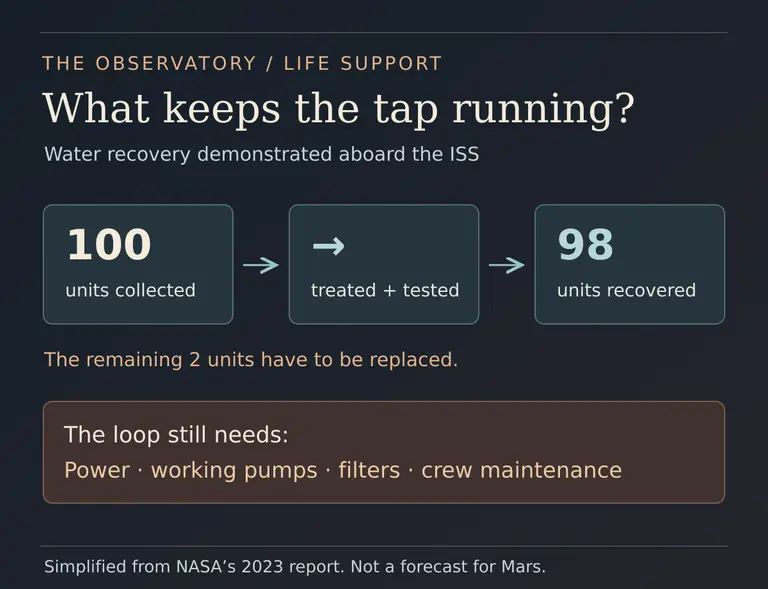
Original explanatory diagram
What keeps the tap running?. NASA demonstrated 98 percent recovery of water collected for processing on the space station. The diagram illustrates that result, not a forecast for Mars.
Credit: The Observatory / jdot
The tap
In June 2023, NASA reported that the International Space Station had demonstrated 98 percent water recovery. Moisture from the crew’s breath and sweat gets collected from the air. A different machine distills water from urine, and a newer device extracts more from the brine it leaves behind. The water then goes through filters and treatment before anyone drinks it. If the system takes in a hundred pounds of water, it can give back about ninety-eight. Compared with the previous 93 to 94 percent recovery, that’s a sizable reduction in the amount that needs replacing.3
It’s an impressive number to put in the city’s budget, provided the machine is running. A decade earlier, the station had trouble with a pump in the assembly that treats recovered water. According to a NASA engineering report, the pump apparently seized. The crew installed a spare. It seized on startup. Engineers traced the spare’s failure to a known issue with ceramic gears during storage; a subsequent pump with different ceramic components worked.4
Think about being the person who checks off that spare on an inventory sheet. It’s physically there; you can lay a hand on the box. Whether it will start after years on a shelf is a question the inventory can’t answer. If the rest of your spares were made the same way and stored alongside it, the fact that you ordered extra might matter less than you’d hoped.
A water reserve buys the crew time to troubleshoot. A second way of getting water might buy a great deal more. A settlement could draw from local ice, where accessible, but it would still have to get the ice out of the ground, remove contaminants and deliver water to the people and equipment that need it. If the ice plant and the recycler use the same vulnerable power supply, they can both be working beautifully right up to the moment neither is. Keeping a second source genuinely independent costs the settlement equipment it might otherwise share. That is the kind of choice a cargo manifest has to reflect.5
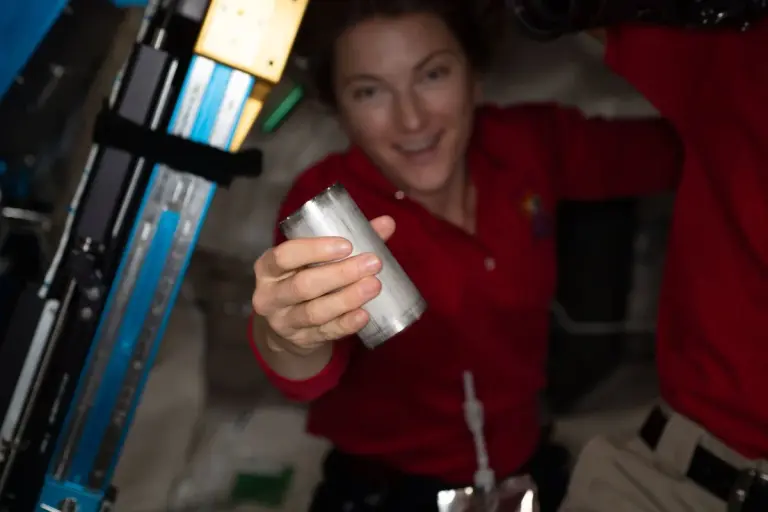
NASA documentary photograph · International Space Station
A filter change in orbit. NASA astronaut Kayla Barron replaces a filter in the Brine Processor Assembly. This is separate from the earlier Water Processor Assembly pump failure described in the article.
Credit: NASA · NASA media guidelines · Converted for web delivery; full frame retained
What you can make
A few years ago, a machine about the size of a toaster made oxygen from the Martian air. It rode to Mars on the Perseverance rover and used electricity to split carbon dioxide, releasing oxygen. Across sixteen runs, the machine, called MOXIE, produced 122 grams of oxygen. Its best rate was 12 grams an hour. The achievement was getting the process to work in the real Martian environment. A crew would need a plant that could make and store useful amounts reliably, with enough power and some provision for the days it stopped.6
Food makes the distinction easier to taste. A greenhouse that gives the crew something crisp to eat after months of packaged meals is worth having. It can be a success on those terms and still leave nearly all of dinner coming from Earth. NASA’s CHAPEA analog missions in Houston used crops to supplement food, not to provide the crew’s entire diet. Before a settlement can put the greenhouse in the emergency plan, someone has to answer how many people it can feed through a bad harvest, what supplies the next planting requires, and how much electricity should go to the grow lights when another system needs it.7
For a while, bringing extra food may be a better use of cargo than trying to grow every meal. A stockpile does its job quietly, without asking anyone to stay up and repair it. A crop can keep yielding long after a stockpile is gone. Which bet makes sense depends on how long the community expects to be there and what else it has to give up to keep the farm running. It’s perfectly reasonable for an outpost to import something a city would want to know how to produce.
The things that make the things
The first functional object NASA printed aboard the space station was a faceplate for the printer’s own extruder. There’s something satisfying about a machine making a piece of itself. The printer was working, though, and the commands and plastic had come from Earth. As a demonstration it was a good start. It left open the messy question of how a crew could make a part for a machine that had already failed, and know the part would hold.8
A Martian workshop could be valuable long before it could make a replacement for everything. A bracket you can measure and test makes a reasonable first job. A new component for a drinking-water system needs evidence that it will survive the conditions inside the machine and won’t contaminate the water. Designing several machines around the same serviceable part might help more than bringing a sophisticated printer. So might leaving enough room for someone to get a wrench on the bolts. The harder tasks require tools, skilled people, time to do the work and a way to test the result. NASA’s Mars supportability study treats crew time and repair capability as design problems alongside the mass of spares.9
Earth would still have plenty to send. Imagine importing electronics that take an elaborate supply chain to make, keeping a tested stock of the ones you depend on, and learning to salvage and swap them locally. There’s no obvious reason every settlement would need its own semiconductor industry. There is a reason to ask how long a delivery can be missed before a particular imported part goes from a nuisance to a threat to the whole water supply. Your answer might be a better spare, or it might be a water system that can keep working without that part.
Go back to that dinner. There’s a version of the evening in which word of the lost shipment sends everyone to the inventory to calculate how long the place can keep people alive. In another, people are upset because the new lab will have to wait, the greenhouse won’t get its expansion, and there won’t be much variety at dinner for a while. They get up the next morning and go about the work of keeping the place going. Both places still need Earth. In the second, the people planning the next shipment have the luxury of asking what they’d like to build.
Sources
Footnotes
JPL’s guide to Mars launch timing
NASA/JPL
Scientific institution
In this article: Favorable Earth-to-Mars launch geometry recurs roughly every 26 months; transit takes months.
Source 1NASA/JPLJPL’s guide to Mars launch timingScientific institutionIn this articleFavorable Earth-to-Mars launch geometry recurs roughly every 26 months; transit takes months.View source ↗NASA’s account of ESCAPADE’s departure
NASA
Scientific institution
In this article: The ESCAPADE probes launched in 2025, loitered near Earth, and departed for Mars after powered flybys in 2026.
Source 2NASANASA’s account of ESCAPADE’s departureScientific institutionIn this articleThe ESCAPADE probes launched in 2025, loitered near Earth, and departed for Mars after powered flybys in 2026.View source ↗NASA’s water recovery report
NASA
Scientific institution
In this article: The ISS demonstrated 98 percent water recovery, up from 93 to 94 percent.
Source 3NASANASA’s water recovery reportScientific institutionIn this articleThe ISS demonstrated 98 percent water recovery, up from 93 to 94 percent.View source ↗NASA’s engineering history, section VI
NASA
Scientific institution
In this article: The apparent pump seizure, spare failure on first startup, and subsequent material change are documented in section VI.
Source 4NASANASA’s engineering history, section VIScientific institutionIn this articleThe apparent pump seizure, spare failure on first startup, and subsequent material change are documented in section VI.View source ↗NASA’s study of shared and independent resource and life-support systems
NASA
Scientific institution
In this article: Shared extraction and life-support components reduce mass but can introduce shared failure modes.
Source 5NASANASA’s study of shared and independent resource and life-support systemsScientific institutionIn this articleShared extraction and life-support components reduce mass but can introduce shared failure modes.View source ↗JPL’s MOXIE mission results
NASA/JPL
Scientific institution
In this article: MOXIE made 122 grams of oxygen in 16 runs and achieved a peak output of 12 grams per hour.
Source 6NASA/JPLJPL’s MOXIE mission resultsScientific institutionIn this articleMOXIE made 122 grams of oxygen in 16 runs and achieved a peak output of 12 grams per hour.View source ↗NASA’s CHAPEA food and crop plans
NASA
Scientific institution
In this article: CHAPEA crops complement prepackaged food.
Source 7NASANASA’s CHAPEA food and crop plansScientific institutionIn this articleCHAPEA crops complement prepackaged food.View source ↗NASA’s account of the first print
NASA
Scientific institution
In this article: The ISS printer made an extruder faceplate using supplied plastic and Earth-sent instructions.
Source 8NASANASA’s account of the first printScientific institutionIn this articleThe ISS printer made an extruder faceplate using supplied plastic and Earth-sent instructions.View source ↗NASA’s study of Mars mission support and repair
NASA
Scientific institution
In this article: NASA weighs repair capability, crew time, and spare-parts mass for Mars missions.
Source 9NASANASA’s study of Mars mission support and repairScientific institutionIn this articleNASA weighs repair capability, crew time, and spare-parts mass for Mars missions.View source ↗