Where Is Everybody?
If the universe appears to provide enormous amounts of time, stars, planets, and potentially habitable environments, why have we found no convincing evidence of extraterrestrial technological civilization?
Short Answer
A living universe does not necessarily look like an inhabited one.
There could be oceans full of organisms, planets covered in microbial ecosystems, and civilizations separated by millions of years—without anyone nearby sending a signal we can recognize.
The working interpretation developed here is that the silence probably has more than one cause: technological civilizations may be uncommon, their conspicuous phases may be brief, and our searches cover only limited combinations of places, times, and kinds of technology. This is a synthesis of the possibilities, not an established solution.
What is established is the gap in our knowledge. Planets are common. We do not know how commonly they become living worlds, how frequently life develops technology, or how long technological societies persist. We still have no scientifically confirmed detection of extraterrestrial life.12
But there is a harder question hiding behind the missing radio messages.
If even a few civilizations survived for millions of years and spread enduring technology between the stars, why is their legacy not obvious?
That is the strongest part of the Fermi paradox. It challenges not just the likelihood of aliens, but our assumptions about what advanced civilizations eventually do.
The evidence leaves room for both a crowded universe that is difficult to observe and a much lonelier one than we expect. The interesting work is figuring out which assumptions separate those possibilities.
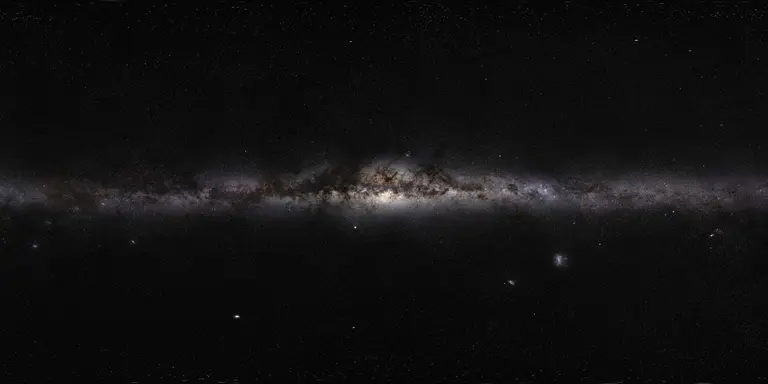
Observational image · Visible-light panorama
Our galaxy, seen from within. A view across the Milky Way grounds the paradox in the scale of our galaxy. Many stars mean many opportunities; they are not evidence that those opportunities produce technology.
Credit: ESO/S. Brunier · CC BY 4.0 · Resized
What the Fermi paradox actually asks
The familiar question is wonderfully simple:
If there are so many stars, where is everybody?
The stronger version adds the assumptions that make it a genuine puzzle:
If technological civilizations arise reasonably often, and some become extremely durable and expansive, why have we found no convincing evidence of them?
That difference matters. A large number of planets does not automatically produce a large number of civilizations. And a large number of civilizations does not automatically produce visitors, messages, or recognizable engineering.
The universe has had a substantial head start
The universe is approximately 13.8 billion years old. The Milky Way contains at least roughly 100 billion stars and spans about 100,000 light-years.34
Small planets also formed long before Earth. The Kepler-444 system, for example, contains five sub-Earth-sized planets around a star estimated to be about 11 billion years old. Those planets are not evidence of ancient life, but they show that small planetary worlds are not a recent invention.5
Now consider a deliberately simplified journey across the Milky Way.
At one percent of light speed, crossing 100,000 light-years takes 10 million years. At one-tenth of that speed, it takes 100 million years.
Those are travel-time calculations, not claims that the engineering is straightforward. They leave out acceleration, repairs, settlement, failed missions, and the availability of suitable destinations.
Still, the comparison is striking:
A journey impossibly long for a person can be relatively short for an old galaxy.
An expanding civilization would not necessarily need one ship to complete the journey. New settlements or autonomous outposts might launch further expeditions. That possibility gives the expansion argument much of its force.6
Figure 1 · Conceptual figure
The Fermi paradox at a glance
- Many opportunities
- At least roughly
100 billion starsin the Milky Way;
planets are common. - A long head start
- 13.8 billion yearsof cosmic history.
- The observation
- No confirmed
alien technologyin our searches so far.
What happens between opportunity and something we can detect?
Many opportunities and a long history, but no confirmed extraterrestrial technology. Stars and planets do not establish how often civilizations arise; limited searches do not establish an empty universe.
Sources: Las Cumbres Observatory; Bryson, S., et al. · 2021; Planck Collaboration · 2020; NASA Science; Price, D. C., et al. · 2020
Missing messages and missing legacies are different problems
A radio message can miss us because it is weak, brief, distant, or pointed elsewhere.
A civilization that has transformed thousands of star systems presents a different challenge. Its activity might leave traces long after its original inhabitants disappear.
This is why “space is big” explains difficult communication better than it explains every version of the paradox.
But expansion models do not all predict a uniformly occupied galaxy. Depending on settlement lifetimes, travel assumptions, and the availability of destinations, inhabited and uninhabited regions can coexist.7
The paradox is therefore not proof that something impossible has happened. It is a warning that our optimistic assumptions about abundance, longevity, expansion, and visibility may not all be true together.
What are the odds?
Before exploring the explanations, it helps to separate the questions people often bundle into “Do aliens exist?”
Here, a technological civilization means an independently originated lineage capable of industrial technology, including active machine descendants. “Now” refers to existence, not whether its light has had time to reach Earth. Universe-wide estimates refer to the observable universe, not an assumed infinite cosmos.
Subjective Estimate
These percentages are provisional, evidence-informed judgments made for this investigation—not measured probabilities, scientific consensus, or calibrated forecasts. Their purpose is to make the working assessment explicit. The sources support the evidence behind the judgments, not the numerical weights.
| Possibility | Working estimate |
|---|---|
| An independent biosphere has arisen elsewhere in the observable universe by the present cosmic age | ~95% |
| Another independently originated technological civilization has existed somewhere in the observable universe | ~85% |
| Naturally occurring life exists somewhere else in the Milky Way now | ~80% |
| Another independently originated technological civilization has arisen in the Milky Way at some point | ~60% |
| Another such technological civilization, or its active technological descendants, exists in the Milky Way now | ~35% |
These are overlapping propositions, not alternatives that should total 100%.
The strongest distinction is between life somewhere and technological neighbors now. The exact percentages are much less secure than that distinction. Different defensible assumptions about life’s origin or civilization longevity could move them substantially.
Why lean toward life elsewhere?
Two developments make that a reasonable working bet.
First, astronomy has turned planets from a matter of speculation into a population we can study. Kepler’s results indicate that small planets are widespread, including planets receiving levels of starlight compatible with potentially temperate conditions.1
Second, some of life’s ingredients occur beyond Earth. Samples returned from asteroid Bennu contain amino acids and all five nucleobases used in terrestrial DNA and RNA. These are products of extraterrestrial chemistry, not discoveries of extraterrestrial organisms.8
Together, abundant opportunities and biologically relevant chemistry push the assessment upward. Life demonstrably can arise; there is no evidence that its ingredients are unique to this planet.
The uncertainty lies in the transition from ingredients to an evolving living system.
Why not certainty?
Because an enormous number of opportunities does not settle a problem when the success rate is almost unknown.
A universe full of suitable worlds could still contain very little life if the origin of life is extraordinarily difficult. Models that allow broad uncertainty in the biological terms of the Drake equation show why even apparently optimistic assumptions need not eliminate a substantial chance of solitude.9
The high universe-wide estimates therefore reflect a judgment that life’s origin is probably reproducible somewhere—not a demonstration that sheer size guarantees it.
Why do the estimates fall closer to home and closer to now?
Each restriction removes opportunities.
“Somewhere in the observable universe” includes vastly more locations than “somewhere in our galaxy.” “At some point in history” allows civilizations that disappeared before Earth formed. “Active now” requires their lifetimes to overlap ours.
The lower technological estimates also reflect an additional working assumption: producing life is probably easier than producing a lineage capable of industry and sustained technological activity. Earth is compatible with that view, but cannot establish its frequency.
And 35 percent for another active Galactic civilization is not 35 percent for detection or contact. A civilization might exist without producing anything our present searches could find.
That is where the explanations become especially interesting.
The explanations that deserve the most attention
We have searched less than it sounds
The search for extraterrestrial intelligence—SETI—is sometimes imagined as a telescope continuously listening to the whole galaxy.
In reality, detecting a signal requires several things to coincide. It must come from somewhere being observed, arrive during the observation, be strong enough, occupy a monitored frequency, and resemble something the analysis can recognize.
A useful analogy is a radio with an enormous number of stations, pointed at different parts of the sky, while the broadcasters may transmit only occasionally.
A 2018 analysis formalized this as a multidimensional “cosmic haystack.” Under its chosen boundaries, the portion searched was tiny. Its famous swimming-pool-versus-oceans comparison was an illustration of that particular model—not a current percentage of every possible way aliens could be detected.10
The searches are nevertheless real and informative. A major Breakthrough Listen survey examined 1,327 nearby stars for particular kinds of radio signals and found no surviving extraterrestrial candidate. Optical searches have also looked for brief laser-like flashes without establishing a detection.1112
The observing effort is expanding. A July 2026 preprint described an automated MeerKAT system that searches alongside other astronomical observations. Since 2022, it had processed more than 1.2 million beam pointings, including repeat visits. That is substantial progress, but not 1.2 million distinct worlds exhaustively checked and declared empty.13
Even Earth illustrates the problem. An idealized comparison found that a powerful Arecibo-class planetary-radar transmission could be detectable across roughly 12,000 light-years, assuming favorable alignment and a highly sensitive, near-term receiver. Ordinary communications were far less conspicuous. A theoretical detection range also does not mean our recent transmissions have already travelled that far.14
The lesson is not that searching is hopeless.
Not finding a civilization means little unless the search was likely to find the kind of civilization being proposed.
That qualification works well for quiet, localized societies. It works less well for civilizations supposedly filling the galaxy with bright beacons or enormous engineering projects.
Life’s beginning may be the hardest step
Life arising from nonliving chemistry is called abiogenesis.
The challenge is not simply making an amino acid. It is getting chemistry to support continuing organization, heredity, and evolution.
There has been genuine experimental progress. Laboratory chemistry has connected pathways producing precursors relevant to RNA, proteins, and lipids. Experiments have also shown RNA-based systems copying functional RNA accurately enough for it to evolve through repeated rounds of replication and selection.1516
These results make parts of the origin-of-life problem more concrete. They do not yet tell us how often a natural planetary environment completes the entire transition.
Earth’s apparently early life provides a reason for optimism, but a subtle selection effect limits the inference: observers can only find themselves on a world where life began early enough to leave time for observers to evolve. Analyses disagree in emphasis, with some finding modest support for relatively rapid origins, but none turns Earth’s history into a reliable universal frequency.1718
Two tempting shortcuts should therefore be resisted.
“The ingredients are everywhere, so life must be everywhere” skips the difficult transition.
“Modern cells are incredibly complicated, so life must be almost impossible” assumes something like a modern cell had to assemble all at once, rather than emerge through simpler precursors.
The honest position lies between those extremes: the pathways are becoming clearer, while their natural success rate remains largely unknown.
Figure 2 · Conceptual figure
Where the uncertainty lives
- PlanetsPlanet occurrenceRelatively well constrainedPlanets are common; habitability is a further question.
- LifeLife’s natural origin rateExtremely uncertainPromising chemistry does not give a frequency for life.
- Complex lifeTransitions beyond one biosphereExtremely uncertainEarth’s history does not establish a universal rate.
- Technological intelligenceA path to technologyExtremely uncertainCognition is not automatically industrial civilization.
- Detectable technologyVisibility to a searchUncertainA civilization can exist without being detectable to us.
An editorial summary of the article’s uncertainties, not measured probabilities. Labels concern occurrence and transitions beyond Earth, not whether these stages exist here. Detectability also depends on timing, distance, signatures, and search coverage. Arrows are questions, not inevitable progress.
Sources: Bryson, S., et al. · 2021; Spiegel, D. S. et al. · 2012; Mills, D. B. et al. · 2025; Emery, N. J. et al. · 2004; Wright, J. T. et al. · 2018
Life may be common while technological intelligence is rare
A planet can be spectacularly alive without producing anyone who wonders about the stars.
Complex cognition has evolved along different terrestrial lineages. Research comparing corvids and apes, for example, documents important similarities in sophisticated cognitive abilities despite their different evolutionary histories.19
But problem-solving intelligence is not the same thing as industrial civilization. Technology also depends on bodies, environments, accumulated knowledge, and ways of preserving and extending innovations.
Earth’s long wait for technological humans is often presented as evidence that the transition must be fantastically unlikely. That interpretation is not secure.
Some evolutionary developments may have had to wait for environmental opportunities, including suitable oxygen levels. A 2025 reassessment of the “hard-steps” model emphasizes that a long delay need not mean a transition was intrinsically improbable throughout that entire interval.20
Waiting a long time for something does not tell us whether it was difficult—or whether it was not yet possible.
Even so, nothing establishes technology as evolution’s inevitable destination. A biosphere is not a civilization waiting to happen.
Countless worlds could develop rich ecosystems without ever developing an antenna.
That possibility remains one of the more compelling explanations because it separates two questions that our imaginations tend to merge: how often nature makes living things, and how often it makes technological societies.
Civilizations may miss one another in time
Suppose a million civilizations appeared throughout the Milky Way over ten billion years.
That sounds crowded—until we ask how long each remained detectable.
If their appearances were spread fairly evenly through that interval, the average number detectable at a given time would be:
| Detectable lifetime of each civilization | Average number detectable at a time |
|---|---|
| 1,000 years | 0.1 |
| 1 million years | 100 |
This is a hypothetical example, not an estimate of the real galaxy.
Its point is simple: a million civilizations across history can still produce a quiet present.
The Drake equation organizes this intuition by separating the rate at which detectable civilizations appear from how long they remain detectable. Its usefulness lies in revealing the unknowns, not making them disappear.9
A detectable lifetime is also not necessarily a civilization’s lifespan. A society might stop producing conspicuous radio emissions without collapsing. A different technology might make it easier to detect. Long-lived artifacts could remain after its creators vanish.21
Distance adds another complication. Observing a civilization 10,000 light-years away means receiving information from 10,000 years ago. The sender could be gone—or a newly emerged civilization could exist there while its first signals are still travelling toward us.
Timing is therefore a powerful explanation for missed communication.
It becomes less complete when civilizations leave traces that outlast them.
Figure 3 · Illustrative example
Civilizations missing each other in time
- Across history
- 1 million civilizations
- Spread over
- 10 billion years
- Each detectable for
- 1,000 years
- Civilization A: its detectable window ends before the illustrated present.
- Civilization B: its detectable window ends before the illustrated present.
- Civilization C: its detectable window ends before the illustrated present.
- Civilization D: its detectable window ends before the illustrated present.
- Civilization E: its detectable window ends before the illustrated present.
- Civilization F: its detectable window ends before the illustrated present.
Detectable window Present: no window overlaps
A million civilizations across history can still produce a quiet present.
The article’s hypothetical million civilizations over ten billion years, each detectable for 1,000 years, gives an average of 0.1 detectable at a time if appearances are spread evenly. Selected schematic rows show one possible quiet present, not a simulation or empirical records. Windows are enlarged for legibility; positions and lengths are not to scale. A detectable window is not necessarily a civilization’s lifespan.
Sources: Sandberg, A. et al. · 2018; Vidal, C., et al. · 2026
Interstellar expansion may be possible without being common or permanent
It is easy to imagine a single ladder:
Intelligence → technology → more energy → more territory → the entire galaxy.
Each arrow hides an assumption.
A civilization might be capable of launching an interstellar mission without being able to maintain settlements indefinitely. Settlements could fail, stop expanding, or develop priorities unrelated to further expansion.
Models of Galactic settlement show that changing such assumptions can produce very different outcomes, including persistent unoccupied regions.7
The difficult objection remains: it may not matter what most civilizations do. A small number of sufficiently durable, expansive lineages could have an outsized effect.6
Nor does “advanced civilizations become efficient” necessarily solve the problem. Greater efficiency could enable more activity rather than less total energy use.
Some searches already constrain especially conspicuous outcomes. A WISE survey of roughly 100,000 galaxies found none consistent with the extreme scenario of technology reprocessing more than about 85 percent of its starlight into mid-infrared emission.22
A more detailed August 2026 preprint examined 129 nearby galaxies and found that none preferred an added component representing the warm waste heat of the technological swarms being modeled.23
Those results do not exclude modest societies around individual stars. They challenge particular pictures of galaxy-spanning energy use.
The silence is most troublesome for civilizations assumed to become abundant, enduring, expansive, and conspicuous all at once.
Humanity may simply be early—or locally alone
Being first in a region does not require being cosmically special. Wherever technological civilizations eventually arise, one must precede the others.
If the path to technology is sufficiently uncommon, humanity could be the first technological lineage in the Milky Way. Or predecessors might have appeared without leaving recognizable, enduring traces.
There is also a separate possibility: much of the universe’s opportunity for life may lie ahead. Models incorporating the long lifetimes of small stars can place substantial opportunity in the distant future, provided planets around those stars remain habitable.24
That does not establish that nobody came before us. Ancient planetary systems already show that opportunities existed much earlier.5
It simply reminds us that “the universe is old” and “we arrived late relative to all possible civilizations” are not the same statement.
Does the Great Filter mean we are doomed?
The Great Filter is a way of asking where the path from nonliving matter to conspicuous, enduring civilization most often fails.
Its strongest form is conditional: if there are many opportunities but very little widespread technological activity, some transition—or combination of transitions—must be restrictive.25
The filter could be behind us: life’s origin, complex cells, or technological intelligence.
It could involve our future: failure to remain technologically active, failure to establish durable descendants, or failure to sustain expansion.
But “filter” does not automatically mean catastrophe. A civilization that remains localized and quiet could contribute to the same observation.
Figure 4 · Conceptual figure
The Great Filter path
Possible filters behind us
- Nonliving chemistry
- Life
- Complex life
- Intelligence
- Technology
Possible future filters
Durable / detectable civilization
Where is the bottleneck? Unknown — perhaps at several transitions.
A reasoning framework, not a discovered mechanism. If opportunities are plentiful but conspicuous, enduring civilizations are scarce, one or several transitions may be restrictive. The location is unknown. Quiet, localized outcomes could also explain the observation; a future filter need not mean catastrophe.
Sources: Hanson, R. · 1998
Could civilizations destroy themselves?
Yes, that is a conceivable explanation. Powerful technologies can create ways for a society to undermine its own survival.
But identifying imaginable dangers is not evidence that extraterrestrial civilizations almost always succumb to them.
A general self-destruction explanation faces demanding questions. Why do no survivors recover? Why do no independent settlements persist? Why do no autonomous systems continue functioning?
The argument becomes especially difficult if technological life arises often.
It is therefore reasonable to take collapse seriously without treating the Fermi paradox as a measurement of humanity’s extinction risk.
Would discovering simple alien life be bad news?
Not automatically.
An independently originated biosphere would make some easier-origin explanations more persuasive. Under a model that also requires durable technological civilizations to be extremely rare, that could shift attention toward later bottlenecks.
But the later bottleneck might concern intelligence, technology, expansion, or visibility—not necessarily self-destruction. And the underlying inference still depends on how much absence our observations actually establish.256
The Great Filter is an argument about missing transitions. We have not discovered a universal barrier with humanity’s name on it.
The stranger possibilities
Some proposals extend familiar engineering. Others require large assumptions about alien motives or the nature of reality. They should not all receive the same evidentiary weight.
The first evidence of aliens could be a machine
An interstellar probe need not carry an atmosphere, a food supply, or generations of biological passengers. Long communication delays also give autonomous systems practical advantages.
Studies of AI-equipped interstellar missions explore these possibilities, alongside difficult problems involving power, radiation, maintenance, and reliability.26
That makes robotic exploration a reasonable engineering expectation. It does not establish that conscious machine civilizations exist.
The especially interesting possibility is a device whose builders are long gone: not an alien visitor in the usual sense, but a surviving product of intelligence.
Yet machines can sharpen the paradox. If they endure longer and travel more readily than biological crews, they might make persistent expansion easier.
“Aliens became machines” changes who—or what—we should look for. It does not automatically explain why nothing is apparent.
The dark forest: perhaps being noticed is dangerous
The dark-forest idea imagines civilizations remaining quiet because discovery could expose them to attack.
It is a conceivable strategic scenario. It is not an unavoidable conclusion of game theory. Its outcome depends on assumptions about detection, vulnerability, attack costs, uncertainty about intentions, and the consequences of revealing oneself.21
Could a civilization eliminate a distant rival reliably? Could the rival disperse? Would an attack expose the attacker? Could institutions and intentions remain stable over enormous travel times?
Different answers produce different strategies.
Radio silence would also not necessarily conceal every trace of a biosphere or technological activity.
The appropriate conclusion is not that aliens must be friendly. It is that we lack evidence for a single hostile strategy governing every civilization.
The zoo hypothesis: perhaps Earth is being left alone
The zoo hypothesis proposes deliberate noninterference: Earth might be protected, observed, or considered unready for contact. It has appeared in scientific discussion since the 1970s.27
A version involving one dominant local civilization is easier to imagine than an agreement among every society in the galaxy.
But its flexibility is also its weakness. Contact can fit the hypothesis; no contact can fit it too. Ambiguous evidence can be described as deliberate concealment.
Without an independent prediction or distinctive observation, the story has little power to distinguish itself from simpler possibilities.
It remains imaginable, not established.
Aestivation: perhaps they are waiting for a colder universe
Aestivation proposes that civilizations devoted to computation might conserve resources until the far future, when colder surroundings could improve the efficiency of certain computations.28
This is an interesting attempt to connect speculative behavior with physical constraints.
Its thermodynamic case has also been challenged. A published critique argues that useful resources for absorbing computational entropy exist now, so the claimed advantage of waiting for a colder cosmic background does not follow in the proposed way.29
Even apart from that dispute, there is a practical question: would preparation, resource collection, or protective infrastructure leave detectable traces?
The idea is intellectually useful. It is not a supported explanation of the present silence.
Panspermia: perhaps life travels between worlds
Panspermia proposes that life can spread through space—for example, inside material ejected from one planet and delivered to another.
Research has examined the conditions under which viable microbes might transfer between Mars and Earth. It identifies a possible pathway, not evidence that this pathway seeded our planet.30
Panspermia must also be distinguished from the delivery of nonliving organic ingredients, for which asteroid samples provide direct evidence.8
Its central limitation is straightforward:
Moving life’s birthplace does not explain how life first began.
It could, however, complicate a future discovery. Martian organisms sharing ancestry with terrestrial life might reveal two inhabited worlds but still only one origin of biology.
Simulation: perhaps the universe was built without neighbors
The simulation argument concerns whether sufficiently advanced civilizations could create artificial observers and what that might imply about observers like us. It is a conditional philosophical argument, not evidence that our universe is simulated.31
The Fermi-paradox version adds another assumption: a simulator omitted aliens.
But a hypothetical simulator could include civilizations, exclude them, or hide them. The silence does not select among those choices.
Until a proposal produces distinctive evidence or predictions, it explains little more than “reality might be different from what we think.”
That possibility is broad enough to fit almost anything—which is precisely the problem.
What might alien life actually be like?
Think ecosystems before ambassadors
A reasonable starting expectation is not a humanoid face. It is something using local chemistry and energy to sustain itself.
This is a working inference from the additional transitions required for technology, not an observation of a representative alien population.
Ocean worlds make the distinction tangible. Saturn’s moon Enceladus has an ice-covered ocean, and Cassini’s measurements revealed phosphates in grains originating from that ocean, adding to the evidence for a chemically interesting environment.32
Now imagine an inhabited ocean beneath a thick shell of ice.
It could support a substantial ecosystem while producing no transmitters, cities, or conspicuous atmospheric signature. From far away, it might remain almost indistinguishable from a sterile world.
An entire living world could fail to enter the conversation.
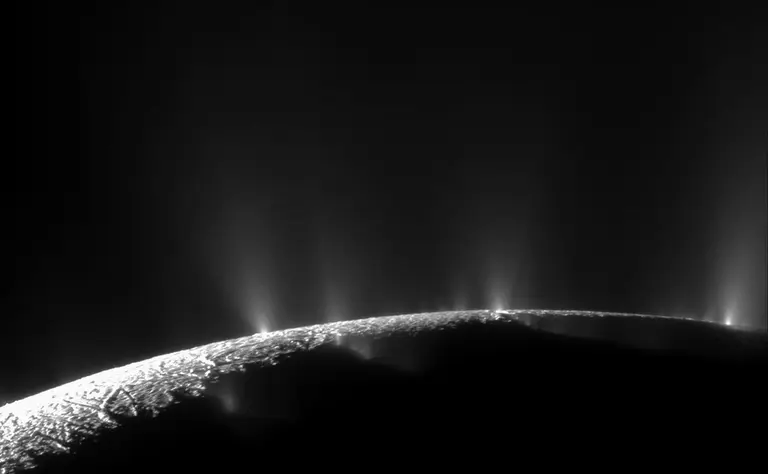
Mission image · Two-image mosaic
An ocean world comes into view. Cassini captured ice and vapor escaping Enceladus’s south pole. The plumes make an otherwise hidden ocean-world environment tangible; this image is not a detection of life.
Credit: NASA/JPL/Space Science Institute
Familiar functions need not mean familiar bodies
Carbon-and-water-based life is the most grounded starting point because it is the biology we know and can connect to measurable environmental conditions. Searches for biosignatures build outward from that knowledge.33
That does not establish that every possible organism uses precisely our chemistry.
Nor does intelligence establish a human-like body, social structure, morality, or interest in Earth. Some physical problems may encourage similar solutions, but predicting a recognizable alien psychology goes far beyond the evidence.
The safest expectations concern functions—obtaining energy, preserving organization, transmitting information—rather than faces or personalities.
Haven’t we already found something?
We have found observations worth investigating. That is different from confirming their biological or technological origin.
The distinction is not pedantry. It is how an interesting candidate becomes a discovery.
Unexplained observations are not automatically extraterrestrial
NASA reports no evidence establishing that unidentified anomalous phenomena, or UAP, are extraterrestrial. It also emphasizes the limitations of the available observations.34
A sincere witness can encounter something genuinely puzzling. A sensor can record an event without collecting enough information to identify it. Neither circumstance establishes an alien cause.
The same discipline applies to telescope data. The blc1 radio signal, found in observations toward Proxima Centauri, initially deserved scrutiny. Follow-up work identified related signals and traced the event to terrestrial interference.35
That was not a failure of scientific curiosity. It was the process working.
An extraterrestrial interpretation needs to explain the evidence better than alternatives—not merely remain compatible with what is unknown.
Mars has a promising candidate, not confirmed fossils
In 2025, researchers reported unusual associations of organic material and minerals in rocks investigated by Perseverance in Jezero Crater, including the Cheyava Falls target.
The patterns are interesting because reactions involving organic matter and these minerals can be connected to biological processes on Earth. But establishing their Martian origin requires distinguishing biological from nonbiological pathways. The primary study identifies laboratory analysis of the returned core sample as important for resolving that question.36
This is a serious reason to investigate.
It is not yet a demonstration that Mars had microbes.
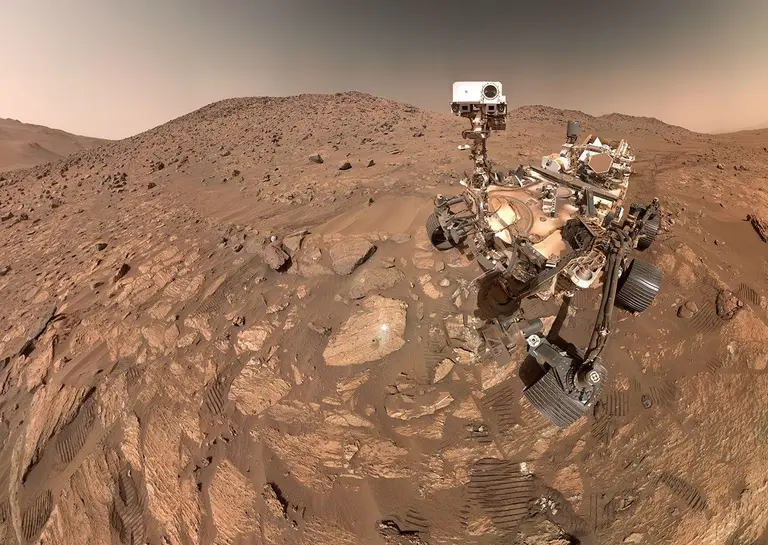
Mission image · Stitched photograph
A question becomes a sample. Perseverance beside Cheyava Falls, the rock sampled in the Mars investigation discussed here. A promising candidate motivates further tests; a photograph cannot establish a biological origin.
Credit: NASA/JPL-Caltech/MSSS
K2-18 b shows how much interpretation matters
An April 2025 analysis of the atmosphere of K2-18 b reported evidence interpreted as dimethyl sulfide, dimethyl disulfide, or a combination of the two. These molecules attracted attention because they might, in some environments, serve as clues to biology.37
An independent analysis found that the claimed molecular evidence disappeared when the set of possible atmospheric models was expanded: other combinations could explain the observations as well or better.38
There are several distinct questions here. Is the spectral feature real? Which molecule produces it? If the molecule is present, what made it?
Even a robust answer to the second question would not automatically answer the third.
A statistical preference within one analysis is not a probability that aliens exist.
What would actually change the answer?
An independently originated second biosphere
This would directly challenge the possibility that Earth represents an extraordinarily singular biological beginning.
The crucial word is independent. A second inhabited world sharing Earth’s ancestry tells a different story from a second origin of life.
The strength of the update would depend on the environment and how the discovery was selected. Even so, finding a separate origin in a comparatively small number of examined environments would push strongly toward life being a repeatable natural outcome.17
It would not settle the frequency of intelligence. It would remove a major uncertainty earlier in the chain.
A technosignature that survives independent scrutiny
A strong candidate would become more persuasive if it could be localized, observed again where repetition is expected, and confirmed by independent instruments or teams.
It would also need to resist natural explanations and interference. The blc1 investigation provides a useful example of why that last stage matters.35
The discovery need not be a message. It might be an engineered object or an environmental alteration with a compelling technological explanation.21
Finding one would establish that another technological lineage existed at the time responsible for the observation. Inferring how common such lineages are would still depend on the circumstances of discovery.
Better-characterized silence
A negative result becomes powerful when the search can say what it would reliably have detected.
Searching a defined population of stars for specified transmitters can constrain those transmitters. Repeatedly finding nothing where a model predicts many detections makes the model less credible.11
The same principle applies to industrial waste heat and other persistent signatures.2223
A future pattern could be even more revealing: many independent biospheres but no technological signs would focus attention on later transitions; repeated technological relics without active sources would focus attention on persistence, abandonment, or transformation. Those are conditional interpretations, but they show what a population of examples could teach us.
The next breakthrough might be a detection. It might also be learning precisely which versions of an inhabited universe the evidence no longer allows.
Bottom Line
The most defensible working explanation is a combination rather than one dramatic revelation.
Life may arise elsewhere without commonly producing technology. Technological civilizations may fail to overlap with us in time. Their signals may be faint, intermittent, or unlike the signatures our searches emphasize. Some may remain localized rather than becoming enduring Galactic powers.
None of those possibilities is a measured universal rule. Together, they show why the absence of a message is not yet compelling evidence of an empty galaxy.
The harder question remains:
Why has no ancient civilization left a legacy so extensive that we could hardly miss it?
That question puts pressure on the whole package of frequent origins, long survival, sustained expansion, and conspicuous activity. At least some of those expectations may be wrong.
The early probability table expresses a provisional view: life somewhere else seems a much better bet than technological neighbors active in our galaxy now. The exact percentages are not the achievement. Understanding why those are different questions is.
A universe could contain living oceans, microbial landscapes, extinct civilizations, and perhaps surviving machines while offering nobody nearby who can answer us.
That would be neither the empty cosmos nor the crowded Galactic community our imaginations usually supply.
It would be something more difficult to picture:
A universe rich in life, but poor in encounters.
Sources
Footnotes
The Occurrence of Rocky Habitable-zone Planets around Solar-like Stars from Kepler Data.
Bryson, S., et al.
The Astronomical Journal · 2021
Primary research
In this article: Occurrence of small, potentially temperate planets around Sun-like stars.
Source 1Bryson, S., et al. · 2021The Occurrence of Rocky Habitable-zone Planets around Solar-like Stars from Kepler Data.The Astronomical JournalPrimary researchIn this articleOccurrence of small, potentially temperate planets around Sun-like starsView source ↗Are We Alone?
NASA Science
Scientific institution
In this article: No scientifically confirmed detection of extraterrestrial life.
Source 2NASA ScienceAre We Alone?Scientific institutionIn this articleNo scientifically confirmed detection of extraterrestrial lifeView source ↗Planck 2018 results. VI. Cosmological parameters.
Aghanim, N., et al. · Planck Collaboration
Astronomy & Astrophysics · 2020
Primary research
In this article: Age of the universe.
Source 3Aghanim, N., et al. · Planck Collaboration · 2020Planck 2018 results. VI. Cosmological parameters.Astronomy & AstrophysicsPrimary researchIn this articleAge of the universeView source ↗The Milky Way Galaxy.
Las Cumbres Observatory
SpaceBook
Scientific institution
In this article: Approximate star count and diameter of the Milky Way.
Source 4Las Cumbres ObservatoryThe Milky Way Galaxy.SpaceBookScientific institutionIn this articleApproximate star count and diameter of the Milky WayView source ↗An ancient extrasolar system with five sub-Earth-size planets.
Campante, T. L., et al.
The Astrophysical Journal · 2015
Primary research
In this article: Ancient formation of small planets in the Kepler-444 system.
Source 5Campante, T. L., et al. · 2015An ancient extrasolar system with five sub-Earth-size planets.The Astrophysical JournalPrimary researchIn this articleAncient formation of small planets in the Kepler-444 systemView source ↗The Ĝ Infrared Search for Extraterrestrial Civilizations with Large Energy Supplies. I. Background and Justification.
Wright, J. T.; Mullan, B.; Sigurdsson, S.; Povich, M. S.
The Astrophysical Journal · 2014
Other source
In this article: The force of durable interstellar expansion in the Fermi paradox; Assumptions behind later bottlenecks in Great Filter reasoning.
Source 6Wright, J. T. et al. · 2014The Ĝ Infrared Search for Extraterrestrial Civilizations with Large Energy Supplies. I. Background and Justification.The Astrophysical JournalOther sourceIn this articleThe force of durable interstellar expansion in the Fermi paradoxView source ↗The Fermi Paradox and the Aurora Effect: Exo-civilization Settlement, Expansion, and Steady States.
Carroll-Nellenback, J.; Frank, A.; Wright, J. T.; Scharf, C.
The Astronomical Journal · 2019
Primary research
In this article: Galactic settlement models with persistent unoccupied regions.
Source 7Carroll-Nellenback, J. et al. · 2019The Fermi Paradox and the Aurora Effect: Exo-civilization Settlement, Expansion, and Steady States.The Astronomical JournalPrimary researchIn this articleGalactic settlement models with persistent unoccupied regionsView source ↗Prebiotic organic compounds in samples of asteroid Bennu indicate heterogeneous aqueous alteration.
Mojarro, A., et al.
Proceedings of the National Academy of Sciences · 2025
Primary research
In this article: Amino acids and nucleobases in Bennu samples; Organic ingredients differ from evidence of panspermia.
Source 8Mojarro, A., et al. · 2025Prebiotic organic compounds in samples of asteroid Bennu indicate heterogeneous aqueous alteration.Proceedings of the National Academy of SciencesPrimary researchIn this articleAmino acids and nucleobases in Bennu samplesView source ↗Dissolving the Fermi Paradox.
Sandberg, A.; Drexler, E.; Ord, T.
2018
Other source · Preprint
In this article: Broad biological uncertainty in the Drake equation; The role of detectable lifetimes in civilization counts.
Source 9Sandberg, A. et al. · 2018Dissolving the Fermi Paradox.Other source · PreprintIn this articleBroad biological uncertainty in the Drake equationView source ↗How Much SETI Has Been Done? Finding Needles in the n-Dimensional Cosmic Haystack.
Wright, J. T.; Kanodia, S.; Lubar, E. G.
The Astronomical Journal · 2018
Primary research
In this article: Limited coverage of a modeled multidimensional SETI search space.
Source 10Wright, J. T. et al. · 2018How Much SETI Has Been Done? Finding Needles in the n-Dimensional Cosmic Haystack.The Astronomical JournalPrimary researchIn this articleLimited coverage of a modeled multidimensional SETI search spaceView source ↗The Breakthrough Listen Search for Intelligent Life: Observations of 1327 Nearby Stars over 1.10–3.45 GHz.
Price, D. C., et al.
The Astronomical Journal · 2020
Primary research
In this article: Narrowband radio search of 1,327 nearby stars and its null result; Negative searches constrain specified transmitters rather than all civilizations.
Source 11Price, D. C., et al. · 2020The Breakthrough Listen Search for Intelligent Life: Observations of 1327 Nearby Stars over 1.10–3.45 GHz.The Astronomical JournalPrimary researchIn this articleNarrowband radio search of 1,327 nearby stars and its null resultView source ↗A VERITAS/Breakthrough Listen Search for Optical Technosignatures.
Acharyya, A., et al. · VERITAS Collaboration
The Astronomical Journal · 2023
Primary research
In this article: Searches for brief optical technosignatures without an established detection.
Source 12Acharyya, A., et al. · VERITAS Collaboration · 2023A VERITAS/Breakthrough Listen Search for Optical Technosignatures.The Astronomical JournalPrimary researchIn this articleSearches for brief optical technosignatures without an established detectionView source ↗Breakthrough Listen’s Automated Commensal Technosignature Survey with MeerKAT.
Czech, D. J., et al.
2026
Primary research · Preprint
In this article: Automated MeerKAT technosignature searches and repeat beam pointings.
Source 13Czech, D. J., et al. · 2026Breakthrough Listen’s Automated Commensal Technosignature Survey with MeerKAT.Primary research · PreprintIn this articleAutomated MeerKAT technosignature searches and repeat beam pointingsView source ↗Earth Detecting Earth: At What Distance Could Earth’s Constellation of Technosignatures Be Detected with Present-day Technology?
Sheikh, S. Z., et al.
The Astronomical Journal · 2025
Primary research
In this article: Idealized detectability of Earth’s radar and other technological emissions.
Source 14Sheikh, S. Z., et al. · 2025Earth Detecting Earth: At What Distance Could Earth’s Constellation of Technosignatures Be Detected with Present-day Technology?The Astronomical JournalPrimary researchIn this articleIdealized detectability of Earth’s radar and other technological emissionsView source ↗Common origins of RNA, protein and lipid precursors in a cyanosulfidic protometabolism.
Patel, B. H.; Percivalle, C.; Ritson, D. J.; Duffy, C. D.; Sutherland, J. D.
Nature Chemistry · 2015
Primary research
In this article: Laboratory pathways to RNA, protein, and lipid precursors.
Source 15Patel, B. H. et al. · 2015Common origins of RNA, protein and lipid precursors in a cyanosulfidic protometabolism.Nature ChemistryPrimary researchIn this articleLaboratory pathways to RNA, protein, and lipid precursorsView source ↗RNA-catalyzed evolution of catalytic RNA.
Papastavrou, N.; Horning, D. P.; Joyce, G. F.
Proceedings of the National Academy of Sciences · 2024
Primary research
In this article: RNA-based replication and selection of functional RNA.
Source 16Papastavrou, N. et al. · 2024RNA-catalyzed evolution of catalytic RNA.Proceedings of the National Academy of SciencesPrimary researchIn this articleRNA-based replication and selection of functional RNAView source ↗Bayesian analysis of the astrobiological implications of life’s early emergence on Earth.
Spiegel, D. S.; Turner, E. L.
Proceedings of the National Academy of Sciences · 2012
Primary research
In this article: Observer selection limits inference from life’s early emergence on Earth; How an independent second biosphere could inform life’s frequency.
Source 17Spiegel, D. S. et al. · 2012Bayesian analysis of the astrobiological implications of life’s early emergence on Earth.Proceedings of the National Academy of SciencesPrimary researchIn this articleObserver selection limits inference from life’s early emergence on EarthView source ↗An objective Bayesian analysis of life’s early start and our late arrival.
Kipping, D.
Proceedings of the National Academy of Sciences · 2020
Primary research
In this article: Bayesian interpretation of life’s early start and the late arrival of observers.
Source 18Kipping, D. · 2020An objective Bayesian analysis of life’s early start and our late arrival.Proceedings of the National Academy of SciencesPrimary researchIn this articleBayesian interpretation of life’s early start and the late arrival of observersView source ↗The Mentality of Crows: Convergent Evolution of Intelligence in Corvids and Apes.
Emery, N. J.; Clayton, N. S.
Science · 2004
Other source
In this article: Similar cognitive abilities in corvids and apes.
Source 19Emery, N. J. et al. · 2004The Mentality of Crows: Convergent Evolution of Intelligence in Corvids and Apes.ScienceOther sourceIn this articleSimilar cognitive abilities in corvids and apesView source ↗A reassessment of the ‘hard-steps’ model for the evolution of intelligent life.
Mills, D. B.; Macalady, J. L.; Frank, A.; Wright, J. T.
Science Advances · 2025
Primary research
In this article: Environmental opportunities as an alternative interpretation of evolutionary delays.
Source 20Mills, D. B. et al. · 2025A reassessment of the ‘hard-steps’ model for the evolution of intelligent life.Science AdvancesPrimary researchIn this articleEnvironmental opportunities as an alternative interpretation of evolutionary delaysView source ↗The Search for Technosignatures: a Review of Possibilities.
Vidal, C., et al.
2026
Scholarly review · Preprint
In this article: Detectability can outlast or differ from a civilization’s lifespan; Assumptions behind dark-forest strategies; Technosignatures beyond radio messages.
Source 21Vidal, C., et al. · 2026The Search for Technosignatures: a Review of Possibilities.Scholarly review · PreprintIn this articleDetectability can outlast or differ from a civilization’s lifespanView source ↗The Ĝ Infrared Search for Extraterrestrial Civilizations with Large Energy Supplies. III. The Reddest Extended Sources in WISE.
Griffith, R. L., et al.
The Astrophysical Journal Supplement Series · 2015
Primary research
In this article: WISE constraints on extreme galaxy-wide mid-infrared waste heat.
Source 22Griffith, R. L., et al. · 2015The Ĝ Infrared Search for Extraterrestrial Civilizations with Large Energy Supplies. III. The Reddest Extended Sources in WISE.The Astrophysical Journal Supplement SeriesPrimary researchIn this articleWISE constraints on extreme galaxy-wide mid-infrared waste heatView source ↗The Ĝ Infrared Search for Extraterrestrial Civilizations with Large Energy Supplies. V. When Galaxies Glow with Industry.
Curtis, O.; Rowland, A. J.; Wright, J. T.; Gronwall, C.; Helton, J. M.; Leja, J.
2026
Primary research · Preprint
In this article: Waste-heat modeling of 129 nearby galaxies without a preferred technological component.
Source 23Curtis, O. et al. · 2026The Ĝ Infrared Search for Extraterrestrial Civilizations with Large Energy Supplies. V. When Galaxies Glow with Industry.Primary research · PreprintIn this articleWaste-heat modeling of 129 nearby galaxies without a preferred technological componentView source ↗Relative Likelihood for Life as a Function of Cosmic Time.
Loeb, A.; Batista, R. A.; Sloan, D.
2016
Other source
In this article: Possible future opportunities for life around long-lived small stars.
Source 24Loeb, A. et al. · 2016Relative Likelihood for Life as a Function of Cosmic Time.Other sourceIn this articlePossible future opportunities for life around long-lived small starsView source ↗The Great Filter—Are We Almost Past It?
Hanson, R.
1998
Other source
In this article: The conditional Great Filter framework and possible bottlenecks.
Source 25Hanson, R. · 1998The Great Filter—Are We Almost Past It?Other sourceIn this articleThe conditional Great Filter framework and possible bottlenecksView source ↗Artificial Intelligence for Interstellar Travel.
Hein, A. M.; Baxter, S.
2018
Other source
In this article: Engineering possibilities and limitations of AI-equipped interstellar missions.
Source 26Hein, A. M. et al. · 2018Artificial Intelligence for Interstellar Travel.Other sourceIn this articleEngineering possibilities and limitations of AI-equipped interstellar missionsView source ↗The Zoo Hypothesis.
Ball, J. A.
Icarus · 1973
Other source
In this article: The historical proposal of deliberate extraterrestrial noninterference.
Source 27Ball, J. A. · 1973The Zoo Hypothesis.IcarusOther sourceIn this articleThe historical proposal of deliberate extraterrestrial noninterferenceView source ↗That is not dead which can eternal lie: the aestivation hypothesis for resolving Fermi’s paradox.
Sandberg, A.; Armstrong, S.; Ćirković, M. M.
2017
Other source
In this article: The proposed computational rationale for aestivation.
Source 28Sandberg, A. et al. · 2017That is not dead which can eternal lie: the aestivation hypothesis for resolving Fermi’s paradox.Other sourceIn this articleThe proposed computational rationale for aestivationView source ↗Comment on ‘The Aestivation Hypothesis for Resolving Fermi’s Paradox’.
Bennett, C. H.; Hanson, R.; Riedel, C. J.
Foundations of Physics · 2019
Other source
In this article: Thermodynamic criticism of the proposed advantage of cosmic aestivation.
Source 29Bennett, C. H. et al. · 2019Comment on ‘The Aestivation Hypothesis for Resolving Fermi’s Paradox’.Foundations of PhysicsOther sourceIn this articleThermodynamic criticism of the proposed advantage of cosmic aestivationView source ↗Natural Transfer of Viable Microbes in Space: 1. From Mars to Earth and Earth to Mars.
Mileikowsky, C., et al.
Icarus · 2000
Primary research
In this article: Conditions for possible transfer of viable microbes between Mars and Earth.
Source 30Mileikowsky, C., et al. · 2000Natural Transfer of Viable Microbes in Space: 1. From Mars to Earth and Earth to Mars.IcarusPrimary researchIn this articleConditions for possible transfer of viable microbes between Mars and EarthView source ↗Are You Living in a Computer Simulation?
Bostrom, N.
The Philosophical Quarterly · 2003
Other source
In this article: The conditional philosophical simulation argument.
Source 31Bostrom, N. · 2003Are You Living in a Computer Simulation?The Philosophical QuarterlyOther sourceIn this articleThe conditional philosophical simulation argumentView source ↗Detection of phosphates originating from Enceladus’s ocean.
Postberg, F., et al.
Nature · 2023
Primary research
In this article: Phosphates detected in material from Enceladus’s ocean.
Source 32Postberg, F., et al. · 2023Detection of phosphates originating from Enceladus’s ocean.NaturePrimary researchIn this articlePhosphates detected in material from Enceladus’s oceanView source ↗Exoplanet Biosignatures: A Review of Remotely Detectable Signs of Life.
Schwieterman, E. W., et al.
Astrobiology · 2018
Scholarly review
In this article: Biosignature searches grounded in known carbon-and-water biology.
Source 33Schwieterman, E. W., et al. · 2018Exoplanet Biosignatures: A Review of Remotely Detectable Signs of Life.AstrobiologyScholarly reviewIn this articleBiosignature searches grounded in known carbon-and-water biologyView source ↗UAP FAQs.
NASA Science
Scientific institution
In this article: UAP observations do not establish an extraterrestrial origin.
Source 34NASA ScienceUAP FAQs.Scientific institutionIn this articleUAP observations do not establish an extraterrestrial originView source ↗Analysis of the Breakthrough Listen signal of interest blc1 with a technosignature verification framework.
Sheikh, S. Z., et al.
Nature Astronomy · 2021
Primary research
In this article: Terrestrial interference as the explanation for blc1; Independent scrutiny and interference checks for technosignature candidates.
Source 35Sheikh, S. Z., et al. · 2021Analysis of the Breakthrough Listen signal of interest blc1 with a technosignature verification framework.Nature AstronomyPrimary researchIn this articleTerrestrial interference as the explanation for blc1View source ↗Redox-driven mineral and organic associations in Jezero Crater, Mars.
Hurowitz, J. A., et al.
Nature · 2025
Primary research
In this article: Organic and mineral associations in Jezero Crater and the need to distinguish origins.
Source 36Hurowitz, J. A., et al. · 2025Redox-driven mineral and organic associations in Jezero Crater, Mars.NaturePrimary researchIn this articleOrganic and mineral associations in Jezero Crater and the need to distinguish originsView source ↗New Constraints on DMS and DMDS in the Atmosphere of K2-18 b from JWST MIRI.
Madhusudhan, N.; Constantinou, S.; Holmberg, M.; Sarkar, S.; Piette, A. A. A.; Moses, J. I.
The Astrophysical Journal Letters · 2025
Primary research
In this article: Reported interpretation of K2-18 b spectra as DMS or DMDS.
Source 37Madhusudhan, N. et al. · 2025New Constraints on DMS and DMDS in the Atmosphere of K2-18 b from JWST MIRI.The Astrophysical Journal LettersPrimary researchIn this articleReported interpretation of K2-18 b spectra as DMS or DMDSView source ↗Challenges in the detection of gases in exoplanet atmospheres.
Welbanks, L., et al.
Nature Astronomy · 2025
Primary research
In this article: Alternative atmospheric models challenge the claimed molecular evidence for K2-18 b.
Source 38Welbanks, L., et al. · 2025Challenges in the detection of gases in exoplanet atmospheres.Nature AstronomyPrimary researchIn this articleAlternative atmospheric models challenge the claimed molecular evidence for K2-18 bView source ↗
Related Questions
- How often does life begin when planetary conditions permit it?
- Would a second biosphere reveal whether life is common?
- Is technological intelligence an evolutionary tendency or a rare accident?
- What would count as convincing evidence of extraterrestrial technology?
- Could an advanced civilization remain difficult to detect for millions of years?
- What does the Great Filter actually imply about humanity’s future?